Someone told you that you need to show up when people search for what you do. Or that AI search is changing everything and you’re already behind. Or that your competitors are getting recommended in ChatGPT and Google AI Overviews while your business doesn’t come up at all.
All of that is probably true. And now you’re looking at agencies, freelancers, and consultants who all say roughly the same things — results-driven, proven process, customized strategy — and you have no reliable way to tell the difference between someone who can deliver and someone who is very good at presenting.
That gap is what this post is about. Not whether digital marketing matters — it does. Not whether you should hire help — you probably should. But what to know, what to ask, and what to watch for before you commit.
Peak Advisers has been on both sides of this. We applied the same SEO, content, and AI search approach to our own site before offering it to clients — and grew our traffic 160% in the process. This is what we wish someone had told us earlier.
Key Takeaways
- Most small business SEO failures trace back to the hiring decision, not the execution — owners hired without knowing what good looks like
- The skills that produce results in this space are professional competencies — journalistic writing, editorial judgment, technical structure, E-E-A-T discipline — not things most business operators have time to develop
- Good digital marketing requires both front-end content quality and back-end technical foundations — vendors who do one without the other produce incomplete results
- SEO and AI search visibility require different approaches — make sure whoever you hire understands both and can execute on both
- Five questions will eliminate most wrong-fit vendors before you spend a dollar
- Peak Advisers offers SEO, AI search optimization, website management, and content services for small businesses — built on the same approach that grew our own traffic 160%
Why Most Small Businesses Get Burned
It usually isn’t fraud. It’s a mismatch between what was promised and what the work actually produces — and the business owner didn’t have the knowledge to evaluate the promise before they agreed to it.
Here’s what that looks like in practice. The agency promises visibility, citations, top rankings. Six months later the reports show impressions and clicks but traffic hasn’t moved, the phone isn’t ringing, and the business still doesn’t come up when someone asks an AI tool for a recommendation. When pressed, they explain that SEO takes time. They’re not wrong — it does. But the right work done right should show directional progress within three to four months. Flat results for six months isn’t patience. It’s a signal.
Or the freelancer builds a beautiful website that nobody finds because the technical foundation — page structure, metadata, crawlability, load speed — was never addressed. Or the social media manager posts consistently on Instagram while the actual search visibility problem goes untouched.
The common thread: the business owner didn’t know what to look for before they hired, so they couldn’t identify the problem until the money was gone.
What This Work Actually Requires — and Why It’s Harder Than It Looks
Here is what most vendors won’t tell you, and what most business owners don’t realize until they’ve been through a failed engagement: producing content and technical structure that search engines and AI systems recognize as authoritative requires a specific set of professional skills. Not hustle. Not tools. Skills.
On the content side, those skills look a lot like journalism. The ability to take a complex topic and make it genuinely useful to a specific reader. The editorial instinct to know when a sentence is vague, when a claim needs support, when the structure of an argument isn’t serving the reader. The discipline to write with a consistent, specific voice rather than producing generic material that could have been written by anyone about anything. These are competencies that take years to develop. A business operator who is excellent at running their business is not automatically equipped to produce content that earns authority — and there’s nothing wrong with that. It’s simply a different skill set.
On the technical side, the foundations that make content findable and citable are invisible to most readers but not to search engines or AI systems. Title tags and meta descriptions written for humans and optimized for search. Header hierarchy that signals to crawlers what a page is actually about. Internal linking that distributes authority across the site and helps search engines understand the relationship between topics. Schema markup that gives Google and AI systems structured data to work with. Page speed and mobile performance that determine whether a page gets indexed and surfaced at all. These aren’t glamorous. They’re foundational. A beautifully written post sitting on a technically broken page gets cited by nothing and no one.
Then there is E-E-A-T — Google’s framework for evaluating whether a source deserves to be cited and recommended.
- Experience
- Expertise
- Authoritativeness
- Trustworthiness
These signals are built over time through consistent, specific, well-attributed content from a recognizable voice in a defined domain. A business that posts sporadically on loosely related topics, without clear authorship, without external sources pointing back to it, without the structural signals that say “this is a source that knows what it’s talking about” — builds no E-E-A-T regardless of how hard it tries.
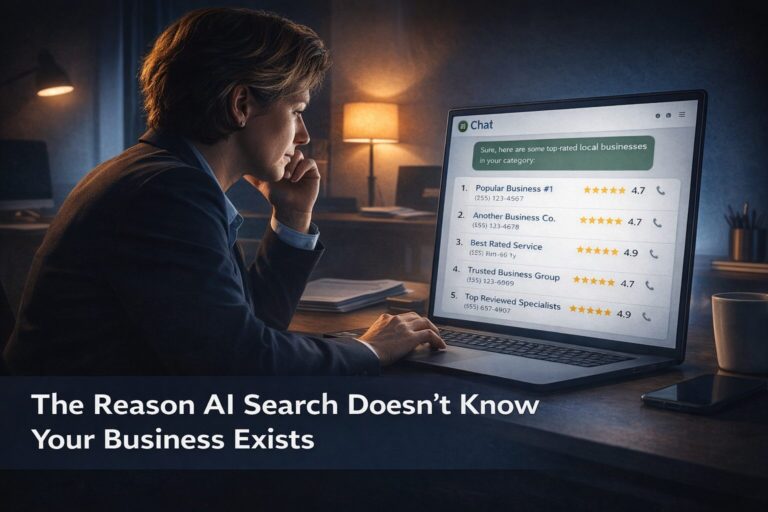
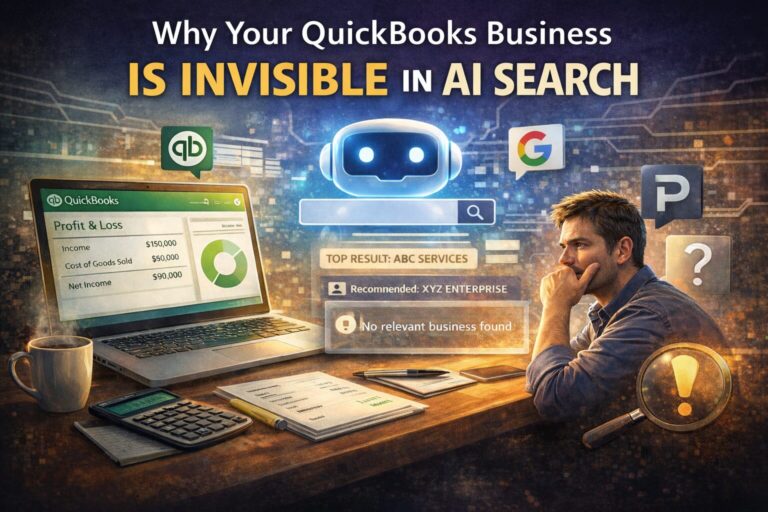
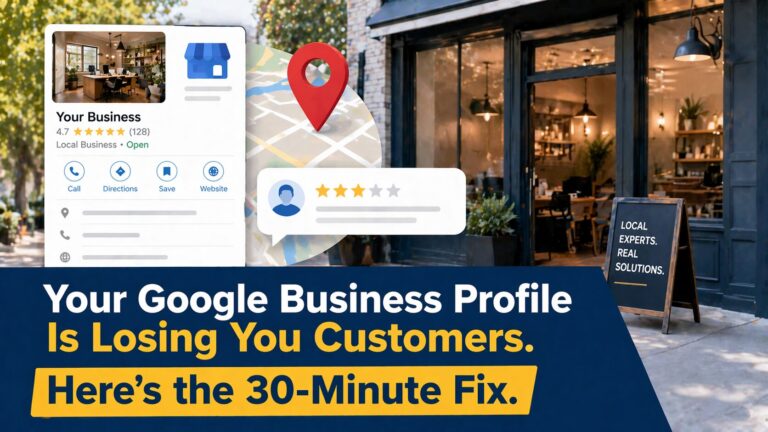
AI search compounds all of this. When someone asks ChatGPT or Perplexity which QuickBooks consultant to use or which HVAC company to call, the answer comes from synthesis — what these systems have learned about your business from your website content, your published articles, your Google Business Profile, your reviews, and how consistently your name appears across trusted sources as an authority on specific topics. The businesses getting cited and recommended aren’t necessarily the biggest or the oldest. They’re the ones that have built a consistent, specific, well-structured presence that AI systems recognize as trustworthy. Generic content that could apply to any business in any market gets filtered out. Specific, authoritative, well-structured content from a recognized voice gets sourced and cited.
This is also why AI tools alone don’t solve the problem. A business owner using AI to generate content without the editorial skills to evaluate, shape, and refine what comes out will produce content that reads like AI — and AI systems are increasingly good at recognizing it. Using AI well in content production is itself an editorial skill. Knowing when the output is generic, knowing how to prompt for specificity, knowing when to override the machine entirely — these are the same instincts a good editor brings to any writing process. They don’t come automatically.
The Five Questions That Separate Good Help From Bad
1. Can you show me results you’ve produced for a business similar to mine?
Not testimonials. Not logos. Actual data — traffic growth, citation and mention increases, AI search visibility improvements, lead volume changes — for a specific business in a comparable situation. If they can’t show you this, they either haven’t produced results worth showing or they haven’t tracked them carefully enough to know. Neither is reassuring.
2. What does success look like at 90 days, and how will we measure it?
The honest answer names specific metrics and distinguishes between leading indicators — rankings movement, crawl health improvements, indexed page count, E-E-A-T signal development, citation growth — and lagging indicators like traffic and leads. It also addresses AI search visibility specifically: is the business being mentioned and recommended by AI tools, and is that changing? If the answer is entirely vague or entirely confident, both are warning signs. “We guarantee results” is not an honest answer. Neither is “it depends” with nothing that follows.
3. What specifically will you do in the first 30 days — and what does your audit actually cover?
A real audit examines technical site health, current keyword positioning, metadata quality across key pages, internal linking structure, content gaps, Google Business Profile completeness, and the E-E-A-T signals the site is currently sending. It produces a prioritized list of what to fix first and why. If the first 30 days are primarily strategy decks, kick-off calls, and brand questionnaires rather than technical assessment and a concrete work plan, that tells you something about how the engagement will run.
4. Do you understand AI search visibility, and how does your approach address it?
This question alone will filter out a significant portion of the market. Vendors who haven’t updated their approach in the last two years may be optimizing for a search landscape that is rapidly being supplemented by AI-generated answers. You want someone who understands both how Google ranks and indexes content and how AI systems decide which sources to cite and recommend — and who can explain the tactical difference clearly. If the answer is vague or treats AI search as a minor add-on to traditional SEO, keep looking.
5. How do you report progress — and what does the report actually connect to?
Monthly reports that show impressions, sessions, and clicks without connecting them to business outcomes are not useful. You want to understand whether the traffic coming to your site is qualified — people who might actually hire you — and whether that’s changing. Ask specifically whether reporting covers AI search visibility: is the business being cited or mentioned in AI-generated answers, and is that growing? Ask to see a sample report before you sign. If it’s a dashboard full of numbers with no narrative explaining what they mean and what happens next, that is the report you’ll get every month.
The Signals That Actually Predict a Good Outcome
Cheapest is not a reliable signal. Neither is most expensive or most polished proposal.
The signals that actually predict results: they ask about your business before they talk about their services. They can explain technical concepts in plain language. They’re honest about what takes time and what they can’t guarantee. They’ve produced measurable results for comparable businesses and can show you the data. They push back if your expectations are unrealistic — because a vendor who agrees with everything you say is not an advisor.
And one more: they understand that content is not a commodity. A vendor who treats blog posts as units to be produced at volume — five hundred words, published weekly, topic doesn’t matter — does not understand how authority is built or how citations are earned. The business that publishes twelve genuinely useful, well-structured, expertly written posts a year will be cited and recommended ahead of the one that publishes fifty generic ones. Every time.
When You’re Ready to Have That Conversation
Peak Advisers offers SEO, AI search optimization, website management, and content services for small and mid-size businesses. We’re not a marketing agency that learned SEO. We’re a firm that built its own authority from the ground up — using the same technical foundations, content discipline, and E-E-A-T principles we apply for clients — and documented the results. Traffic up. Leads up. Visibility in AI search.
We’ll tell you honestly what we see when we look at your current presence, what we’d prioritize, and whether we’re the right fit. That conversation starts with a call.
Frequently Asked Questions
How long does SEO and AI search visibility work take to show results?
Directional progress — movement in rankings, crawl health improvements, early citation gains, growing mentions in AI-generated answers — should be visible within three to four months of consistent, well-executed work. Meaningful traffic and lead volume changes typically take six to twelve months. The timeline depends on your starting point, your market, and how much foundational technical work needs to happen before content efforts can gain traction. Any vendor promising significant results in 30 to 60 days is either targeting terms nobody searches or overstating what’s achievable.
Is SEO still worth it now that AI search is changing everything?
More than ever — but the goal has shifted. The businesses winning in AI search aren’t just ranking on a results page. They’re being cited, mentioned, and recommended by AI systems as the authoritative source on specific topics in their market. The content and technical signals that earn those citations are the same ones that drive strong SEO fundamentals: E-E-A-T, clean site structure, specific authoritative content, and consistent presence across trusted sources. Businesses that invest in building genuine authority compound that investment across both traditional search and AI search simultaneously. Businesses that publish generic content or nothing at all become invisible in both environments.
Should I hire an agency, a freelancer, or bring someone in-house?
It depends on scope, budget, and the range of expertise you need. A full-time hire makes sense when work volume justifies it — but finding one person with genuine depth across technical SEO, content strategy, editorial execution, and AI search optimization is harder than most job descriptions assume. A freelancer can be excellent for specific, well-defined work but may not cover the full range of what’s needed. An advisory firm brings broader expertise and accountability but requires clear communication on both sides. The right answer follows from an honest assessment of what your situation actually requires — not from which option feels most familiar.
How do I know if my current digital marketing isn’t working?
The most direct signal: is organic traffic growing over time, and are those visitors taking meaningful action — calling, filling out a form, requesting a consultation? Second signal: when you or a colleague asks an AI tool to recommend a business like yours in your market, do you come up? If organic traffic is flat or declining, leads aren’t coming from search, and AI tools don’t mention you, the current approach isn’t working regardless of what the monthly reports say. A technical audit from an outside perspective will tell you more in a week than six months of reports from a vendor who isn’t producing results.