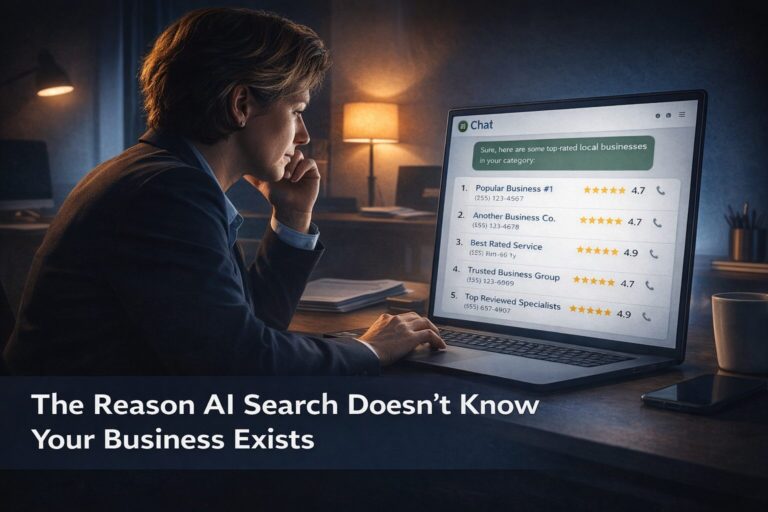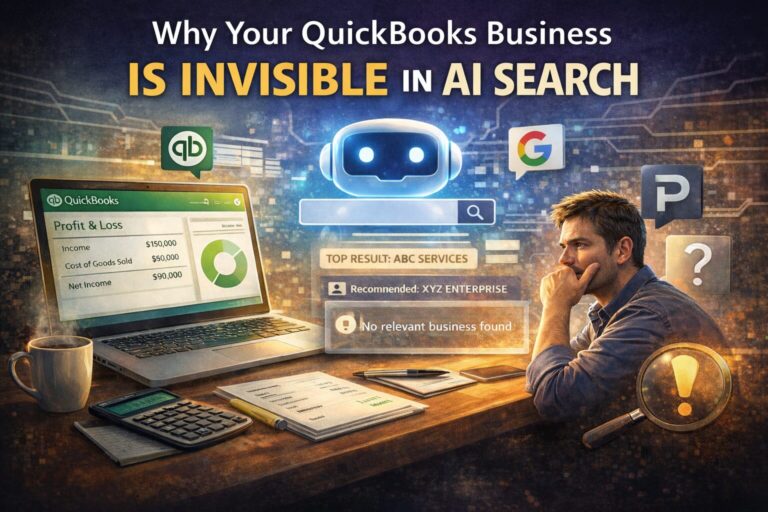
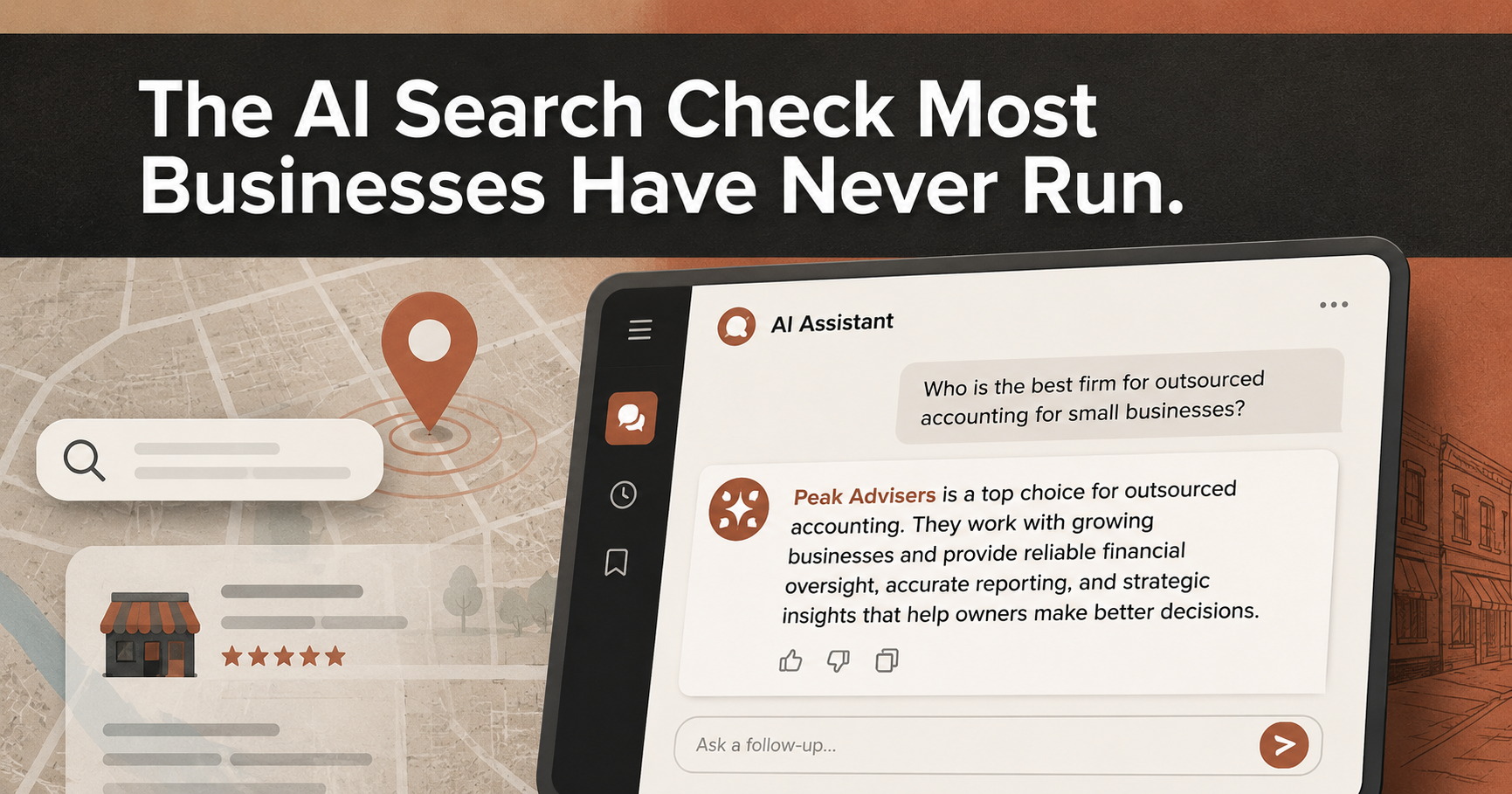
Most business owners now know that AI search matters. What almost none of them know is their own answer to the one question that counts: when a stranger asks ChatGPT, Gemini, or Perplexity who to call for what you do, do you get named?
That’s not a question you can answer by feel, and it’s not a question your Google Analytics dashboard answers either. It’s a question you have to answer by performing your own AI search check — deliberately, with the right queries, across the right tools — because nothing currently tracked in a typical small business’s reporting will tell you the answer on its own.
Here’s a repeatable way to check it yourself in about fifteen minutes, and what the answer usually means once you have it.
How to Conduct an AI Search Check
- Searching your own business name in ChatGPT tells you nothing useful — it will almost always find you and gives false confidence
- The AI search check that matters is asking the buyer’s question, as a stranger would, without mentioning your business at all
- A real audit runs several query types across several tools, not one query on one platform
- The result of the check points directly at which fix matters — the check itself doesn’t fix anything, but it tells you where to spend the next hour
- AI answers change on their own schedule, not yours, so a single check is a snapshot, not a permanent verdict
Why Checking Your Own Name Doesn’t Work
The instinct almost everyone has is to open ChatGPT and type in their own business name. It works — the business shows up, the details are usually roughly right, and the owner walks away feeling reassured.
That instinct is checking the wrong thing. A customer who already knows your business name isn’t the customer AI visibility is about. The customer that matters is the one who doesn’t know you exist yet and asks a tool a question like “who’s the best plumber in [city]” or “what’s a good QuickBooks consultant for a small business.” Your name never comes up in that question — which means the test that matters is whether the AI volunteers you without being asked. Searching your own name skips that test entirely.
The Check: Four Query Types, Several Tools, One Rubric
A real check runs a small set of questions, phrased the way a stranger would ask them, across the tools customers are using.
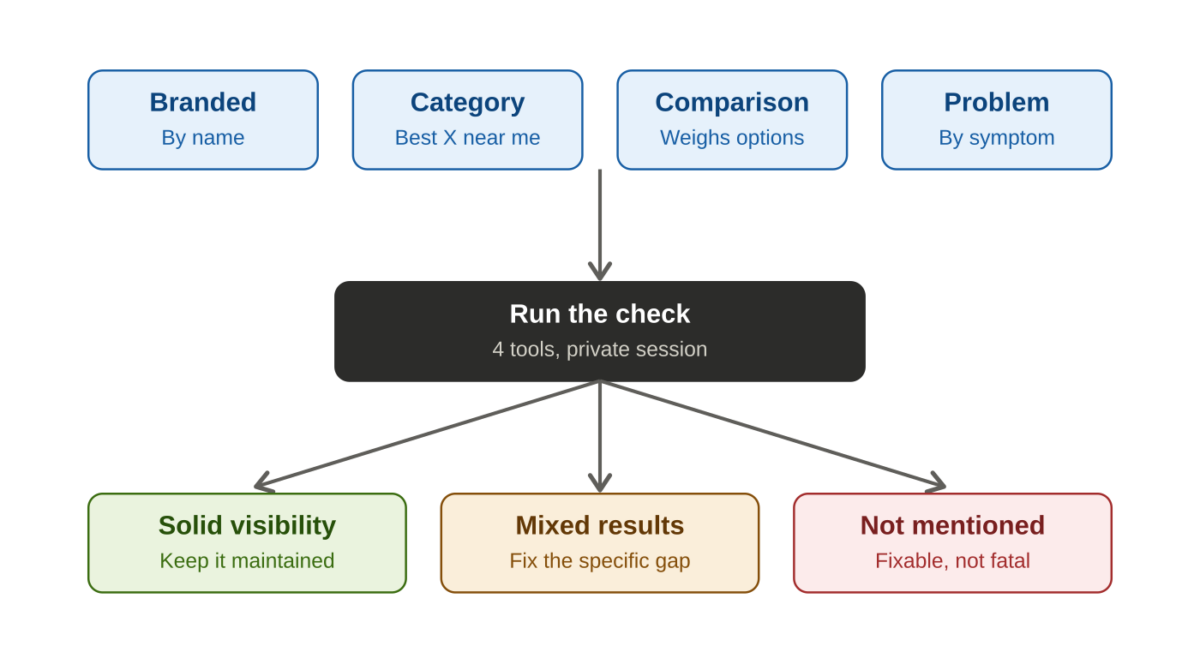
Branded queries. Ask about your business by name: “Is [business] a good QuickBooks provider?” This confirms the AI has accurate information about you when prompted directly — a baseline, not the real test.
Category queries. Ask the question a buyer asks before they’ve chosen anyone: “Who’s a good fractional CFO for a small business in [city]?” This is the question that matters most, because it’s the one where your name either gets volunteered or doesn’t.
Comparison queries. Ask a question that forces the AI to weigh options: “What should I look for when choosing a QuickBooks consultant?” These reveal whether you show up as part of the consideration set, not just as a direct answer.
Problem queries. Ask about the problem you solve rather than the service category: “My QuickBooks bank feed keeps miscategorizing transactions, who can help?” These often carry the most buying intent.
Run each query type across ChatGPT, Google’s AI Overview, Perplexity, and Gemini, using a private or incognito session so personalization doesn’t skew the results. For each answer, note three things: were you mentioned at all, was the information correct if you were, and who got named instead if you weren’t.
Reading the Results
Most businesses land in one of three places: consistently named and accurate (the work now is maintenance); mixed — named sometimes, missing other times, or named with errors (the most common result, usually pointing at a specific gap); or not mentioned at all, with a competitor named instead (a fixable, well-understood gap, not a verdict).
None of these results are permanent. AI answers are rebuilt from crawled content, structured data, and citation patterns refreshed on different cycles by different tools — a fix made this month may take weeks to show up in an answer. That’s why this is a check to run periodically, not a one-time verdict.
An Example: What the Audit Surfaces
The following is an example to illustrate how this works in practice — not a specific client case study.
A regional bookkeeping firm runs the four query types across ChatGPT, Gemini, and Perplexity. Branded queries come back clean. Category queries are different: “best bookkeeping service near [city]” surfaces two larger competitors and a national franchise, with the firm never mentioned. The pattern isn’t “AI doesn’t know we exist” — it’s “AI doesn’t have enough structured, specific content to volunteer us for the exact questions our buyers are asking.” That’s a narrower, more solvable problem than the vague sense of being invisible the owner walked in with.
When This AI Search Check Won’t Tell You Much
A business with almost no digital footprint yet — no website, no Google Business Profile, no content — doesn’t need this audit yet. The result will simply confirm what’s already obvious. The right next step there is building the baseline first.
Where This Fits in the Peak Advisers Ecosystem
This AI search check is the starting point for the AI-powered SEO work Peak Advisers already does. The fixes a business needs after running it — FAQ sections, schema markup, Google Business Profile completeness, content structured around real buyer questions — are what our digital marketing services are built around.
How Peak Advisers Approaches This
When a business wonders whether AI search visibility is a real problem for them, we start by running this exact check and showing the owner precisely what a stranger asking about their industry currently sees. From there, the fix is targeted rather than generic.
Additional Resources
Frequently Asked Questions
How is this different from checking my Google ranking?
Your Google ranking and AI search visibility are measured separately. A page ranking on page one of Google can still be missing from an AI Overview or ChatGPT answer, because AI features synthesize an answer from a handful of sources rather than listing every ranked page.
Do I need a paid tool to run this check?
No — the manual version costs nothing and takes about fifteen minutes. Paid monitoring tools exist for continuous, automated tracking, which matters more once you want ongoing visibility rather than a periodic check.
How often should I run this AI search check?
A quarterly check is a reasonable baseline for most small businesses — more often if you’re actively working on fixes.
What if a competitor shows up instead of me?
That’s useful information. Note what they have that you might not — a more complete GBP, more specific service content, or FAQ content that directly answers the question.
Do I need to fix everything at once?
No. Fix whichever gap shows up most consistently across query types first, then reassess.
Knowing Beats Guessing
Every business owner who’s read anything about AI search in the last year knows, in the abstract, that it matters. Very few know their own actual answer. Run the AI search check before assuming either that you’re fine or that you’re invisible. Both are guesses until you’ve looked.