FedEx’s money-back guarantee still promises a refund when a covered package arrives late, but it covers fewer services than it once did, and FedEx doesn’t issue the refund unless you ask for it. For most invoiced shippers, the request has to reach FedEx within 15 calendar days of the invoice date. A FedEx late delivery refund is easy to request one shipment at a time and hard to collect consistently, because that window usually closes before anyone in the business looks at the invoice.
This guide covers which FedEx services qualify right now, what counts as late (including FedEx’s holiday schedule), how to file, what gets claims denied, and how to record the credits in QuickBooks so they show up in your real shipping cost.
Key Takeaways
- FedEx’s money-back guarantee currently covers its overnight services, 2Day A.M., the overnight Extra Hours contract services, and its international priority services, for U.S. payers. FedEx Ground, Home Delivery, 2Day, and Express Saver remain suspended.
- FedEx won’t refund a late package on its own. The payer has to request it within 15 calendar days of the invoice date, or 15 days from the ship date for card and prepaid shipments.
- During peak season and some holidays, FedEx temporarily extends A.M. delivery commitments on select services, and the printed label may still show the original time.
- The refund covers transportation charges only. Surcharges, duties and taxes, and special handling fees aren’t part of it.
- Billing errors run on a separate, longer clock: FedEx accepts overcharge disputes for 180 days from the invoice date.
- An automated audit such as Share a Refund exists for the gap between FedEx’s 15-day window and a monthly bookkeeping cycle.
Which Shipments Qualify for a FedEx Late Delivery Refund Right Now
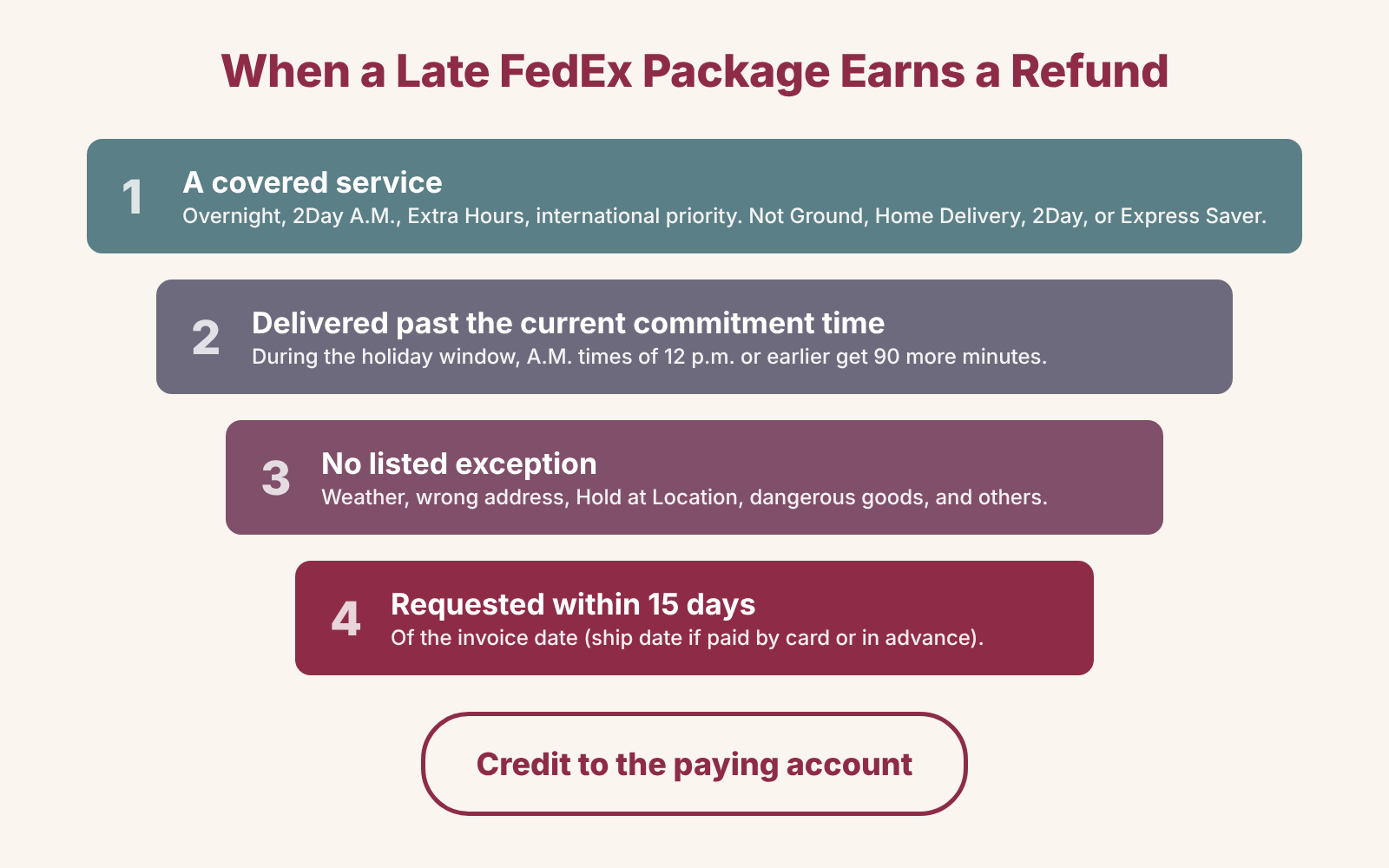
FedEx publishes the current status of its guarantee on its money-back guarantee page. As of the most recent update there (effective Feb. 12, 2026), the guarantee applies to these services for U.S. payers:
- U.S. domestic: FedEx First Overnight, FedEx Priority Overnight, FedEx Standard Overnight, and FedEx 2Day A.M.
- Contract services: FedEx First Overnight Extra Hours, Priority Overnight Extra Hours, and Standard Overnight Extra Hours
- International (U.S. import and export): FedEx International First, International Priority, International Priority Express, International Priority Freight, International Priority DirectDistribution, and International Priority DirectDistribution Freight
FedEx says the guarantee for all other FedEx services remains suspended until further notice. That includes FedEx Ground, FedEx Home Delivery, FedEx 2Day, and FedEx Express Saver, services many small businesses rely on. A late Ground package doesn’t qualify for a refund, however late it arrives.
This is where older guides, including earlier versions of this one, send shippers in the wrong direction. A business that books 2Day because it believes the guarantee backs it is paying for a promise FedEx has set aside. If on-time arrival matters enough to pay for, the service choice matters as much as the claim process.
The list also changes without much warning. FedEx’s Service Guide says the guarantee can be suspended, modified, or revoked at FedEx’s discretion. Last peak season, FedEx suspended it for its overnight and international services for packages shipped on or after Dec. 1, 2025, and reinstated the domestic services for packages shipped on or after Jan. 13, 2026. Check the guarantee page before relying on it for a time-critical shipment, and again before filing.
FedEx’s Holiday Delivery Times for the 2026 Peak Season
This section is time-sensitive. It applies from Nov. 23, 2026, through Jan. 4, 2027.
To handle seasonal volume, FedEx is extending A.M. delivery commitment times of 12 p.m. or earlier by 90 minutes from Nov. 23, 2026, to Jan. 4, 2027. Per FedEx’s money-back guarantee page, the extension applies to these time-definite services:
- U.S. domestic: FedEx First Overnight, Priority Overnight, 2Day A.M., First Overnight Extra Hours, Priority Overnight Extra Hours, First Overnight Freight, and 1Day Freight
- U.S. inbound international: FedEx International First, International Priority, International Priority DirectDistribution, and International Priority Express
FedEx also notes that residential deliveries with a 1:30 p.m. commitment may be extended by 90 minutes, and that printed labels may not show the extended time.
In practice, a Priority Overnight package with a 10:30 a.m. commitment that arrives at 11:45 a.m. during this window is on time, even though the label says 10:30. Teams that compare delivery scans to label times will flag packages that don’t qualify, and a claim filed on those will be denied.
Two standing exceptions in the FedEx Service Guide also apply during the holidays. FedEx doesn’t owe a refund on a package due the Wednesday before Thanksgiving that arrives within 90 minutes of its commitment, or on a package scheduled for delivery in the seven days before Christmas that arrives by the end of its commitment date.
What a Refund Covers, and What Gets a Claim Denied
The money-back guarantee is narrower than “your money back.” According to the FedEx Service Guide, it refunds or credits the transportation charges for a package delivered 60 seconds or more after its published delivery commitment. FedEx’s definition of transportation charges leaves out surcharges, declared-value charges, special handling fees, and customs duties and taxes. The guarantee applies to each package in a multiple-piece shipment, allows one refund or credit per package, and pays the account that was billed. If a customer’s or a fulfillment partner’s FedEx account paid for the shipment, the refund belongs to that account.
The Service Guide lists the circumstances in which FedEx doesn’t owe a refund even when a package arrives late. The ones that catch shippers most often:
- Circumstances FedEx doesn’t take responsibility for: weather, natural disasters, strikes, transportation network disruptions, acts of government agencies, and incorrect or incomplete addresses, among others listed under “Liabilities Not Assumed”
- Payment problems: an account not in good standing, or a delivery held up waiting on payment
- Hold at Location: the package was rerouted to a FedEx Hold at Location address
- Undeliverable or returned packages
- Dangerous goods: any shipment containing dangerous goods, unless dry ice is the only one
- Address and recipient issues: an incorrect address or ZIP code, or no one eligible available to accept or sign
- Security or regulatory procedures at the recipient’s location
- Oversize packages
Two scheduling rules also move the target. If a shipper or recipient tells FedEx before the first attempt that the location is closed, the commitment moves to the next business day. If either one asks for a later delivery before the first attempt, the commitment moves to match. The Service Guide’s terms also apply unless a separate agreement modifies them, so a shipper with a negotiated FedEx contract should confirm what its own agreement says about the guarantee.
How to Request a FedEx Late Delivery Refund
FedEx’s Service Guide names the channels it accepts, and a request sent any other way doesn’t count.
- Confirm the package qualifies. Check the service against the current guarantee list, then compare the delivery scan to the commitment time in FedEx tracking, adjusted for any holiday extension. Don’t rely on the label.
- Gather three details. FedEx requires the account number (if there is one), the tracking number, and the ship date. Have the invoice number ready too.
- File through an accepted channel. Registered users can file through FedEx Billing Online at fedex.com, or use the invoice adjustment feature on fedex.com. FedEx also takes requests by phone through its invoice adjustment system at 1.800.463.3339; say “billing” at the prompt.
- File inside the window. FedEx has to receive the request within 15 calendar days of the invoice date. If you paid by credit card, or in advance by cash, check, or money order, the 15 days run from the ship date.
- Watch for the credit. An approved request comes back as a credit to the paying account or a refund to the payer. Match it to the original charge when it arrives (see the QuickBooks section below).
One trap is worth knowing before it costs a refund. Under the Service Guide, paying part of an invoice doesn’t count as a refund request, and neither does a note explaining why a late package’s charge went unpaid. Short-paying FedEx’s invoice for a late package doesn’t preserve the claim. Only a request through one of the channels above does.
Why Most Eligible Refunds Never Get Filed
Very few businesses decide to skip their FedEx refunds. The refunds go unclaimed because FedEx’s clock and the business’s bookkeeping run on different schedules. The 15-day window starts on the invoice date, not the day someone opens the invoice. Many businesses pay FedEx on autopay and review shipping costs when they close the month, by which point several invoices are past the deadline.
The work itself is also tedious at any real volume: pulling delivery scans, checking each one against the right commitment time (including holiday extensions), confirming the service was covered on the ship date, and ruling out exceptions. When that work belongs to no one, it doesn’t happen, and the cost hides inside a shipping line that looks normal from month to month.
The following is a hypothetical example to illustrate how this works in practice — not a specific client case study.
A specialty food producer ships about 30 Priority Overnight packages a week to restaurant and retail accounts, and FedEx invoices the account weekly. The bookkeeper pays the invoice on autopay and reviews shipping when closing the month. In the first week of a month, three packages arrive after their 10:30 a.m. commitment because of a sorting delay, with no weather event or other exception involved.
At an illustrative $40 in transportation charges per package, those three packages are worth $120 in credits. The invoice is dated the following Monday. When the month-end review happens about three weeks later, the window has already closed. No one decided to give the money up; the review happened after the deadline. If the same thing happens a few weeks a year, the business has paid full price for a guarantee it never used, and the product’s shipping cost per order looks higher than it is.
A more careful month-end review wouldn’t have saved these credits, because the deadline passed before the review started. What would have saved them is a check that runs inside the 15 days: a weekly review that someone owns, or an audit service that checks every invoice as it posts.
Late Deliveries Are Only One Line on the FedEx Invoice
A late delivery refund is the most time-sensitive recovery on a FedEx invoice, and the other recoveries sit in the charges added on top of the base rate. FedEx’s own documents set the rules those charges follow. The Service Guide bills each package at the greater of its actual or dimensional weight, and FedEx’s published surcharge list includes an Address Correction fee and a Residential Delivery Charge. When a package is measured wrong, an address that was correct gets “corrected,” or a business address is classified as a residence, the charge built on it is wrong too.
Parcel audit firms’ published FedEx audit guides describe the same recurring categories. They list dimensional weight errors, address correction charges, residential surcharges applied to commercial addresses, and duplicate charges for the same shipment, alongside late deliveries, as the errors audits most often turn up.
These disputes run on a longer clock. The FedEx Service Guide accepts requests for an invoice adjustment due to an overcharge within 180 days of the original invoice date (or the ship date for card and prepaid shipments). That gives a business time to catch billing errors in a monthly review, but late deliveries don’t get that grace period.
Where Share a Refund Fits
Share a Refund, a certified Peak Advisers partner, audits FedEx and UPS invoices, files the claims that qualify, and charges a share of what it recovers. That model fits the problem described above. The audit runs on every invoice as it posts, so late deliveries get checked against the current guarantee rules while the 15-day window is still open, and billing errors get flagged while there is still time to dispute them.
It also changes who carries the work. Instead of asking a bookkeeper or operations manager to compare delivery scans every week, the business reviews what was recovered. Because the fee is a share of recoveries, there is nothing to pay on shipments that turn out to be on time or excluded.
Peak Advisers handles the setup with clients and connects the result to their books, so recovered credits land in the right place in QuickBooks and the shipping numbers leadership relies on reflect what the business really paid. If you ship with both FedEx and UPS, our overview of UPS and FedEx shipping refunds covers how the two carriers’ guarantees and filing windows differ.
When Filing It Yourself Makes More Sense
An audit service earns its keep when there’s enough covered volume for late packages to add up. A few situations call for a different conversation first:
- Your FedEx shipping is almost all Ground or Home Delivery. With the guarantee suspended on those services, there are no late delivery refunds to recover right now. Billing errors may still be worth a look, and that’s a good question to bring to us before signing up for anything.
- You send a handful of overnight packages a month. Filing the occasional request yourself through FedEx Billing Online may be all you need. Set a weekly reminder tied to the invoice date, not the month-end close.
- Someone else’s account pays for your shipments. If a customer, marketplace, or fulfillment partner is billed, the refund belongs to them, and the conversation is about who audits that account.
- You have a negotiated FedEx agreement. Read the guarantee terms in your contract before assuming the published policy applies.
If you’re not sure which of these describes your shipping, contact Peak Advisers and we’ll look at your service mix and invoice pattern with you before you decide.
Recording FedEx Refund Credits in QuickBooks
Recovered credits only help decisions if they’re recorded against the cost they reduce. A credit that lands in the wrong place, or never gets matched to an invoice, leaves shipping expense overstated and the FedEx balance hard to reconcile.
Intuit’s help article “Enter vendor credits and refunds in QuickBooks Online” lays out three methods, and the right one depends on how you record FedEx purchases:
- You enter FedEx invoices as bills. Create a vendor credit for FedEx using the same category as the original charge, and QuickBooks applies it when you pay the next bill.
- You record FedEx charges as expenses or card purchases. When the refund arrives as money back, record it as a bank deposit received from FedEx and use the same category as the original expense, so the refund reduces shipping expense instead of showing up as income.
- You’ve already paid the bill and FedEx sends a refund. Create the vendor credit, record the deposit to Accounts Payable, and connect the two through Pay bills.
A few practices keep the numbers clean. Record an audit service’s fee as its own expense rather than netting it against the credits, so you can see both what was recovered and what recovery cost. If you charge customers for shipping, keep shipping income separate from shipping expense so the credit doesn’t blur your margin on shipping. And reconcile recovered credits to the FedEx statement each month, so a credit that was approved but never applied gets caught.
This matters beyond tidy books. Shipping cost per order feeds pricing, free-shipping thresholds, and decisions about which customers and channels are worth growing. If refunds are recorded inconsistently, those decisions rest on a number that’s off in a direction nobody can see.
Frequently Asked Questions
Does FedEx refund late deliveries automatically?
No. FedEx issues a money-back guarantee refund only when the payer requests it through one of the channels in its Service Guide: FedEx Billing Online, the invoice adjustment feature on fedex.com, or its phone invoice adjustment system at 1.800.463.3339.
How long do I have to request a late delivery refund from FedEx?
FedEx has to receive the request within 15 calendar days of the invoice date. If you paid by credit card, or in advance by cash, check, or money order, the 15 days run from the ship date.
Is FedEx Ground covered by the money-back guarantee?
Not currently. FedEx says the guarantee remains suspended for all services outside its published list, which includes FedEx Ground, Home Delivery, 2Day, and Express Saver. Billing errors on Ground shipments can still be disputed as overcharges.
Does FedEx’s holiday schedule change what counts as late?
Yes. During peak season and around some holidays, FedEx temporarily extends A.M. delivery commitment times on select time-definite services; recent extensions have added 90 minutes. Printed labels may not show the extended time. FedEx lists current and past extensions on its money-back guarantee page, so check it before filing a claim for a package delivered during a holiday period.
Who gets the refund if my customer’s FedEx account paid for shipping?
The account that was billed. FedEx’s Service Guide says credits go only to the payer’s account and refunds only to the payer, so a shipment billed to a customer or a fulfillment partner is theirs to claim.
How long do I have to dispute a FedEx overcharge?
FedEx accepts invoice adjustment requests for overcharges within 180 days of the original invoice date, or of the ship date for card and prepaid shipments. That’s separate from the 15-day window for late delivery refunds.
Keep the Guarantee Working for You
FedEx’s guarantee is part of what you pay for when you choose a covered service, and the refund depends entirely on a request reaching FedEx in time. The businesses that collect it consistently have a check inside the 15-day window and record what comes back where it belongs.
If you’d like help setting up an audit with Share a Refund, or want to make sure recovered credits show up correctly in QuickBooks, contact Peak Advisers. We’ll look at how you ship, what you’re likely leaving on the invoice, and how to connect the recovery to the numbers you use to run the business.
FedEx guarantee status, holiday commitment times, and filing rules verified against fedex.com and the 2026 FedEx Service Guide on Nov. 20, 2026. FedEx can change the guarantee without notice; check its money-back guarantee page for current status.