The most common reason a business owner delays hiring a fractional CFO isn’t cost. It’s that they can’t picture what they’d be paying for.
They understand the concept — someone senior thinking about cash, margin, and forecasting instead of just closing the books. What they can’t see is the sequence: what gets looked at first, what gets built, and what’s different by day 90 that wasn’t different on day one. Without that picture, the decision stalls, and the business keeps running on gut instinct for another quarter.
A fractional CFO engagement isn’t a subscription to vague strategic guidance. It follows a specific arc. Here’s what that arc looks like.
Key Takeaways
- The first 30 days are assessment — reviewing the books, the cash position, and the reporting the owner is currently making decisions with
- Days 31–60 are where structure gets built: a cash forecast, a reporting cadence, and a small set of KPIs tied to how the business actually makes money
- By days 61–90, the fractional CFO is running a repeatable monthly rhythm rather than still discovering the business
- The most common finding in the first 30 days isn’t fraud or negligence — it’s decisions being made on numbers that were technically accurate but strategically incomplete
- A fractional CFO engagement depends on clean, current bookkeeping underneath it — the quality of the QuickBooks data determines how fast the first 30 days can move
Days 1–30: What Gets Assessed
The first month isn’t strategy work. It’s diagnosis.
A fractional CFO starts by reviewing the chart of accounts, the last 12 months of financials, the current cash position, and — critically — whatever reports the owner is actually using to make decisions right now. That last part matters more than it sounds. Most owners aren’t short on data. They’re short on data that’s structured to answer the questions they’re actually asking.
This is usually where the first real finding shows up. Not fraud, not negligence — just a gap between what the books say and what the owner believes to be true. A margin that looks healthy in the P&L but is being propped up by one large account that’s about to churn. A cash position that looks stable because a seasonal dip hasn’t hit yet. An expense category so broad it’s hiding three different problems at once.
The tradeoff in this phase is speed against accuracy. An owner who wants strategic recommendations in week one is going to get recommendations built on an incomplete picture. The assessment takes the time it takes because every decision built on top of it depends on getting this part right.
Days 31–60: What Gets Built
Once the assessment is done, the second month is construction — turning the diagnosis into tools the business will actually use going forward.
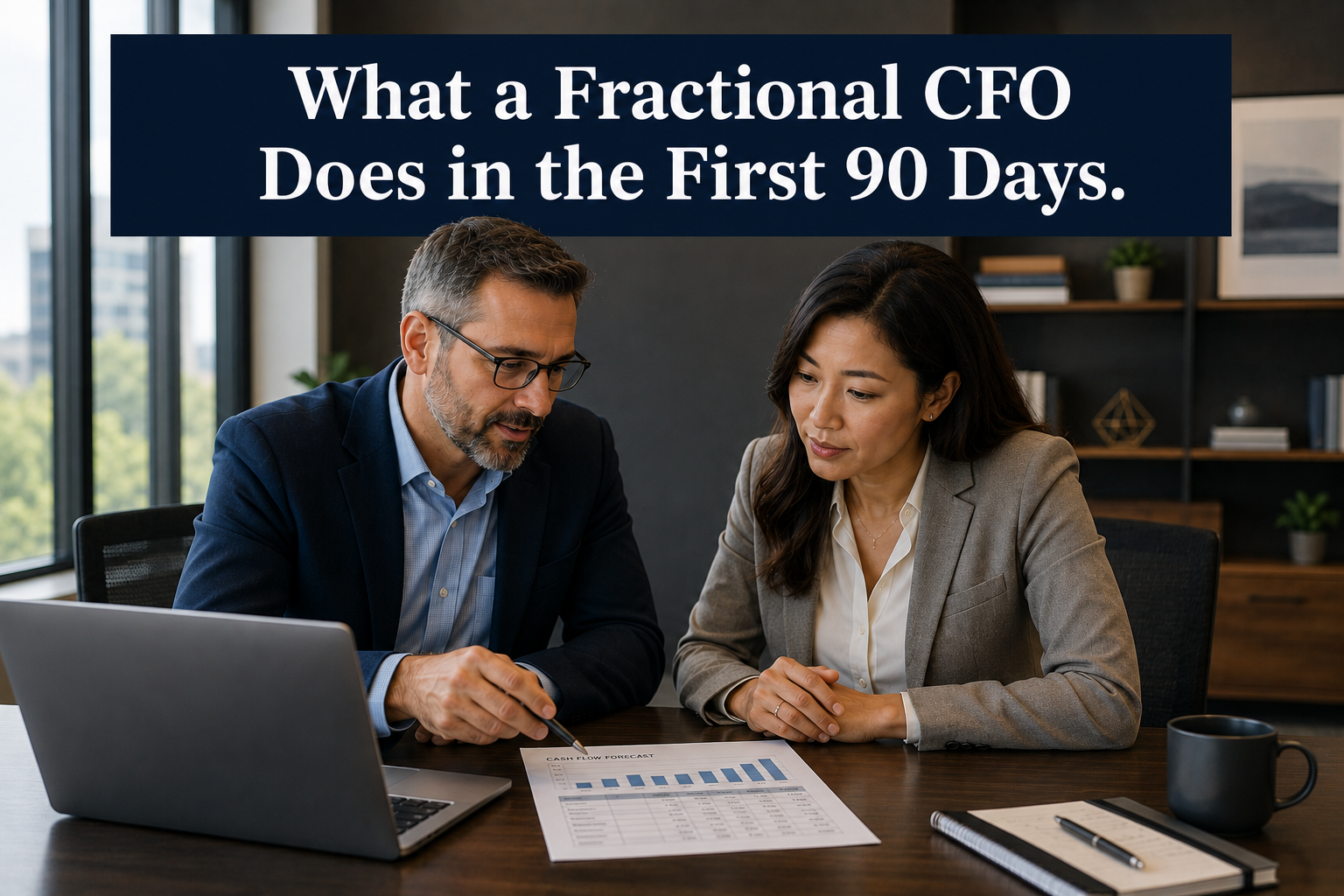
The centerpiece is usually a rolling cash flow forecast, typically 13 weeks out, rebuilt from actual receivables and payables timing rather than a flat monthly average. For most owners, this is the first time they’ve seen cash pressure coming before it arrives instead of after.
Alongside the forecast comes a reporting cadence — a small, consistent set of numbers the owner reviews on a fixed schedule, not whenever a spreadsheet gets assembled. And a KPI set gets defined: usually five to ten metrics tied directly to how that specific business makes or loses money, not a generic dashboard template.
The failure pattern this phase is built to prevent: a business that has plenty of reports but no single number anyone trusts enough to make a decision on. If leadership meetings regularly end in disagreement about whose spreadsheet is right, that’s the exact problem this structure is designed to close.
Days 61–90: What’s Running
By the third month, the engagement stops being about discovery and starts being about rhythm.
Monthly close feeds directly into the forecast and KPI reporting instead of requiring separate reconstruction. Leadership meetings run off one set of numbers instead of competing versions assembled by different people. And the fractional CFO is now positioned to flag emerging issues — a customer concentration risk, a margin that’s drifting on a specific product line, a cash gap forming three months out — before they become the reason for an emergency meeting.
This is also where the cost-of-inaction case becomes concrete. A business that skipped this process is still finding out about cash problems the week they happen. A business 90 days into a fractional CFO engagement is finding out about them a quarter in advance — which is the entire difference between managing a problem and reacting to one.
An Example: The Margin That Wasn’t What It Looked Like
The following is an example to illustrate how this works in practice — not a specific client case study.
A specialty manufacturing business brought in a fractional CFO after a year where revenue grew 20% but the owner couldn’t explain why cash felt tighter than it had the year before. In the first 30 days, the review found that one product line — responsible for nearly a third of revenue — was being sold at a margin low enough that growth in that line was actively working against overall profitability. The blended margin reported each month had been masking this because it averaged across product lines instead of separating them.
By day 60, product-level margin reporting was built into the monthly numbers, along with a 13-week cash forecast that accounted for that product line’s slower payment terms. By day 90, the owner had renegotiated pricing on that line and had a forecast that finally matched what was happening in the bank account. Revenue growth stopped being treated as an automatic win — a distinction that had been invisible in the original reporting.
When the Timing Isn’t Right Yet
A fractional CFO engagement depends on having financials that are current and reasonably accurate to work from. If the books are several months behind, or the chart of accounts hasn’t been touched since the business was half its current size, that gap needs to close first — otherwise the first 30 days of the engagement get spent on cleanup instead of diagnosis.
That’s not a reason to wait indefinitely. It’s a reason to have the QuickBooks structure addressed alongside the CFO conversation, not instead of it. Peak Advisers handles both sides of this — the bookkeeping foundation and the fractional CFO relationship — so the sequencing gets planned rather than discovered halfway through.
Why the Books Underneath Matter
None of this works without clean data feeding it. A fractional CFO’s forecast is only as reliable as the receivables and payables it’s built from, and the KPI reporting is only useful if the chart of accounts is structured to actually separate the things leadership needs to see separately.
This is where the QuickBooks relationship and the fractional CFO relationship connect directly. Peak Advisers has been a certified QuickBooks Solution Provider since 2011, and the fractional CFO work is built on that same foundation — a properly structured QBO or Intuit Enterprise Suite file underneath the forecasting and reporting, not a CFO practice operating independently of the books.
How Peak Advisers Runs This Engagement
The 90-day arc described here isn’t a generic framework — it’s the sequence Peak Advisers uses with every fractional CFO client, adjusted for what the assessment actually finds.
Some businesses need the full 90 days before the cash forecast is trustworthy. Others have cleaner books going in and move through assessment faster, spending more of the first quarter on KPI structure and forecasting depth. What doesn’t change is the order: assess first, build second, run third. Skipping the assessment to get to recommendations faster is how businesses end up with a forecast built on numbers nobody has verified.
Frequently Asked Questions
How much does a fractional CFO cost compared to a full-time hire?
A full-time CFO typically runs well into six figures annually in salary and benefits. Fractional engagements are scoped to the hours and access level a business actually needs, which is usually a fraction of that cost. Peak Advisers scopes pricing based on the complexity of the business and the reporting cadence required — not a flat monthly rate applied regardless of fit.
Do I need my QuickBooks file cleaned up before starting?
Not necessarily, but the state of the books determines how the first 30 days go. If the file is current and reasonably accurate, assessment moves quickly. If it’s significantly behind, that cleanup gets folded into the early part of the engagement rather than treated as a separate project.
What’s the difference between a fractional CFO and my current bookkeeper or CPA?
A bookkeeper and CPA are focused on accurate historical records and tax compliance — essential functions, but backward-looking by design. A fractional CFO works from that same data to build forward-looking tools: cash forecasting, KPI tracking, and scenario planning tied to where the business is headed, not just where it’s been.
How much time does this take from me as the owner?
The heaviest time commitment is in the first 30 days, during the assessment, when the fractional CFO needs access and context from leadership. By day 90, the ongoing rhythm is typically a scheduled monthly or biweekly review rather than ongoing back-and-forth.
Is this only for businesses that are already struggling?
No — some of the clearest cases for this are businesses that are growing quickly and losing visibility into their own numbers as a result, not businesses in distress.
What the Business Looks Like on the Other Side
By day 90, the difference isn’t a stack of new reports. It’s that leadership decisions stop starting with “let me pull some numbers together” and start with numbers that are already current, already trusted, and already pointing at what’s coming next.
If you’re evaluating whether a fractional CFO makes sense for where your business is right now, that conversation is worth having before the next quarter forces the question.
Schedule a call with Peak Advisers →
Read: The Reason Profitable Businesses Run out of Cash →