The numbers exist. They’re just in three different files, two spreadsheets, and someone’s memory.
That’s the situation more often than owners want to admit. QuickBooks Online was the right call when the business had one entity, one location, and a financial structure that matched what a single QBO file was built to handle. The problem is that businesses grow in ways that accounting software doesn’t automatically follow — and the gap between what the system can do and what the business actually needs tends to fill with manual workarounds before anyone identifies it as a structural problem.
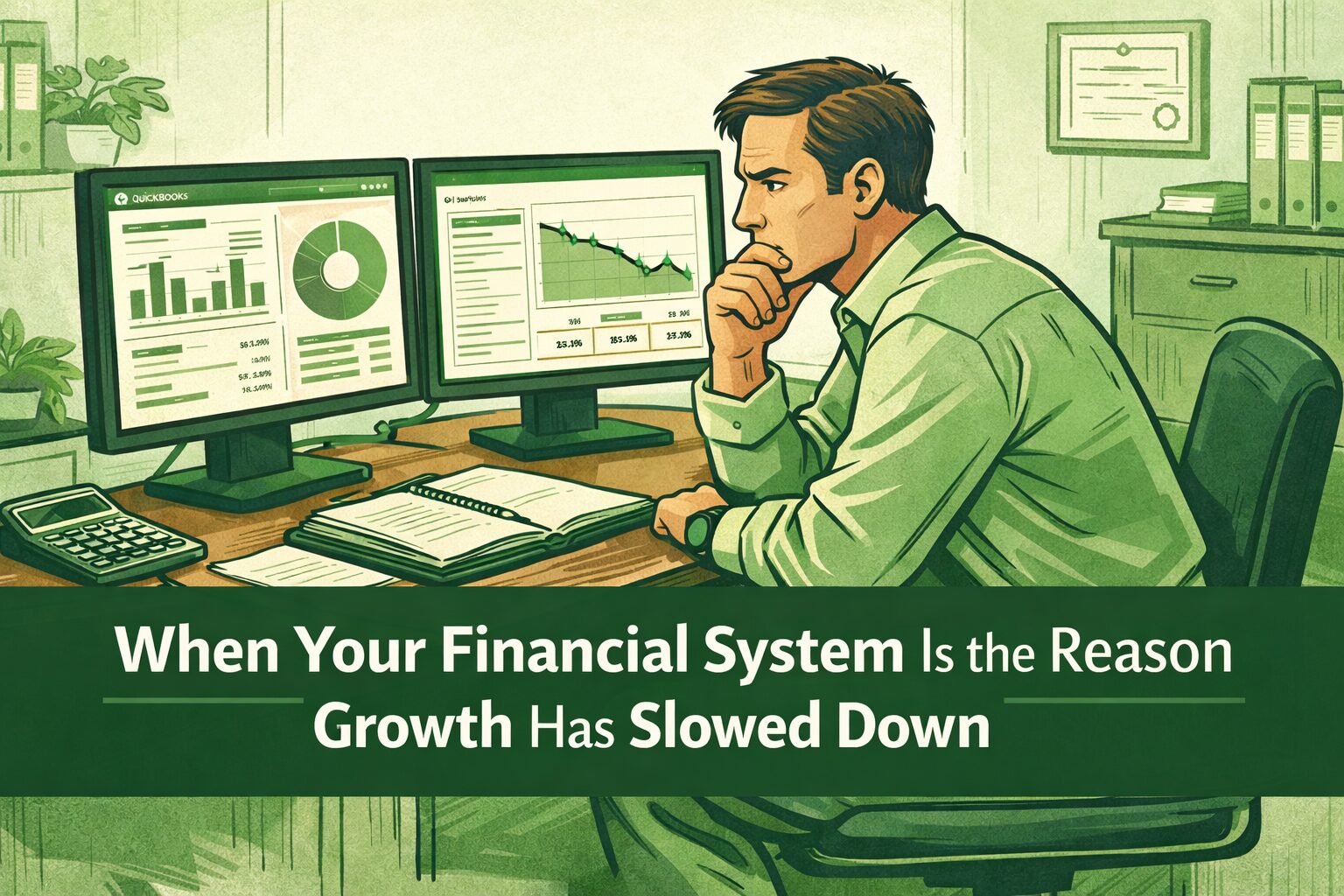
By the time a business owner is spending three days assembling the monthly report their leadership team needs in an hour, the system isn’t a tool anymore. It’s a bottleneck.
This post is for owners and operators who feel that friction but haven’t been able to name it yet.
Key Takeaways
- QuickBooks Online is purpose-built for single-entity businesses with straightforward financial structures — and it does that job well
- Multi-entity management, consolidated reporting, intercompany transactions, and project-level profitability are the areas where QBO most commonly reaches its limits
- The workarounds businesses use — duplicate data entry, spreadsheet consolidation, add-on tools — mask the problem without resolving it
- Intuit Enterprise Suite is not a replacement for QBO — it is a separate platform built for businesses that have grown past what QBO was designed to support
- The decision to move is not primarily a software decision — it is a decision about whether the current financial structure can support the next phase of growth
The Signs That QBO Has Reached Its Limit
QuickBooks Online has a specific design intent: a single business entity, a manageable number of users, and a financial structure that can be expressed within one set of books. When a business fits that profile, QBO performs exactly as designed.
The friction begins when the business outgrows the structure, not the software. These are the most common signals:
Multiple entities with no unified view. Managing two or three QBO files simultaneously means logging in and out of separate accounts, entering intercompany transactions by hand, and assembling consolidated financial data outside the software entirely — usually in a spreadsheet. There is no native consolidated view. Every report requires manual synthesis.
Reporting that requires assembly. When the CFO or owner needs a picture of overall business performance and the answer is “give me two days to pull that together,” the reporting infrastructure has failed. That delay is not a staffing problem. It is a structural one.
Project profitability that lives in Excel. For construction companies, professional services firms, and any project-based business, knowing which jobs made money and which ones didn’t is the core question. QBO has job costing tools, but they have limits — particularly for businesses tracking costs across multiple dimensions, managing progress billing at scale, or comparing actuals against detailed project budgets in real time.
Class and Location tracking that’s been pushed past its design. Many businesses use QBO’s Class and Location features as workarounds for more complex dimensional reporting needs. It works until it doesn’t — and it usually stops working when the business adds an entity, a division, or a reporting requirement that requires more than two dimensions simultaneously.
User access that doesn’t match the organizational structure. Growing businesses have controllers, operations managers, project leads, and external accountants who all need different levels of access to financial data. QBO’s permission structure has limits, and those limits become visible when the business tries to give the right people access to the right information without exposing everything to everyone.
What Actually Breaks First — and Why It Matters
The first thing that usually breaks is not the software. It is the close process.
When a business with two or three entities is running on separate QBO files, month-end close requires someone to reconcile intercompany transactions manually, export data from each file, consolidate it in a spreadsheet, and then review it for errors introduced during that assembly process. That process takes time — often days — and it introduces error at every step.
The second thing that breaks is decision-making speed. When leadership needs a consolidated picture of business performance and the answer requires several days of work, decisions get made on incomplete information or delayed until the data is ready. In a fast-moving business, that delay has a cost.
The third thing that breaks is trust in the numbers. Once a business owner has found a significant error in a manually consolidated report, they stop fully trusting the reports that follow. That erosion of confidence in financial data is more damaging than the original error — because it affects every decision downstream.
None of these breakdowns announce themselves clearly. They tend to show up as slow closes, spreadsheet proliferation, extra bookkeeping staff added to manage volume that should be handled by the system, and growing unease in leadership meetings where the numbers don’t quite add up in the way they should.
The Workarounds — and Why They Buy Time, Not Solutions
When a business hits these limits, the instinct is usually to add resources rather than change the structure. The workarounds are predictable:
A second bookkeeper or controller hired specifically to manage the consolidation work. This solves the labor problem without addressing the system problem — and it means the business is now paying a person to do work that the right software would handle automatically.
Spreadsheet consolidation. Export from QBO File A, export from QBO File B, paste into the master Excel file, manually adjust for intercompany eliminations, spot-check for formula errors. This is the most common workaround and the most error-prone. It also means the consolidated view is always at least partially out of date.
Third-party consolidation add-ons. There are tools built to consolidate multiple QBO files into a unified view. They work, within limits. They also add a dependency, a monthly cost, and an integration that requires maintenance — and they still don’t solve the underlying data architecture problem.
Aggressive use of Classes and Locations. Businesses that push QBO’s dimensional reporting features past their design intent often end up with a chart of accounts or class structure so complex that it takes significant expertise to navigate — and still doesn’t deliver the reporting the business actually needs.
Each of these workarounds has a version of the same problem: they treat a structural issue as a workflow issue. The effort invested in maintaining the workaround grows over time while the business grows more complex and the gap between what the system can show and what leadership needs to see gets wider.
What Intuit Enterprise Suite Is — and Is Not
Intuit Enterprise Suite (IES) is not an updated version of QuickBooks Online. It is a separate platform, built for businesses that have moved beyond what QBO was designed to support.
The distinction matters because the upgrade conversation is not about features. It is about financial architecture.
IES is built around multi-entity management from the ground up. Multiple legal entities, subsidiaries, locations, and divisions can be managed within a single system, with a unified chart of accounts, automated intercompany transactions, and consolidated reporting that updates in real time rather than requiring manual assembly. Leadership can see the full organizational picture — and drill into any individual entity — without changing files or rebuilding data in a spreadsheet.
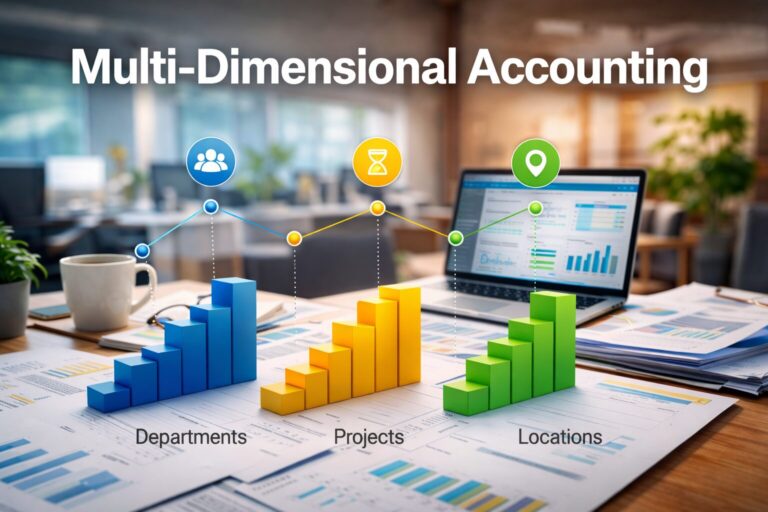
The platform also handles multi-dimensional reporting at a level that QBO’s Class and Location structure cannot match. Businesses can track performance across combinations of dimensions — region, department, project type, cost center — within a single ledger, rather than relying on workarounds that approximate the result.
IES is not the right choice for every business. It is designed for companies with meaningful financial complexity: multiple entities, project-based operations, or reporting requirements that have outgrown what a single QBO file can support. For a single-entity business with straightforward financials, QBO remains the appropriate tool — and often the best one.
A Hypothetical Example: Two Entities, One Spreadsheet Too Many
The following is a hypothetical example to illustrate how this works in practice — not a specific client case study.
A specialty contracting business has grown to the point where the owner operates two legal entities: the primary operating company and a real estate holding entity that owns the building where the business operates. Both entities have financial activity. The operating company pays rent to the holding entity. The holding entity has its own set of books, its own expenses, and its own tax obligations.
Each month, the bookkeeper logs into two separate QBO files, records the intercompany rent transaction in both, exports financials from each, and manually assembles a consolidated view in Excel. The process takes most of a day. The consolidated report is then reviewed by the owner and the CPA, who occasionally finds errors in the manual assembly — usually small ones, occasionally significant ones.
The owner wants to add a third entity: a new operating division serving a different market. At that point, the monthly close process will require reconciling three separate files, three sets of intercompany transactions, and three exports into a single consolidated Excel file. The bookkeeper has already said they don’t have capacity for it.
This is not a staffing problem. This is a system that was designed for a different version of the business.
In IES, all three entities would exist within a single system. The intercompany rent transaction would be recorded once, with the offsetting entry handled automatically. Consolidated reporting would be available in real time, without export or manual assembly. The monthly close that currently takes a day would take a fraction of that time.
When This Is the Wrong Move
IES is not the right answer for every business that feels friction in QBO.
If the business operates as a single entity with straightforward financials, the right solution is almost always better QBO implementation — not a platform change. Many of the problems that feel like software limitations are actually setup problems: a chart of accounts that wasn’t designed for the business, bank feed rules that haven’t been configured correctly, or reporting that hasn’t been structured to show what leadership actually needs.
If the business is considering IES primarily because it finds QBO confusing, that is also not a sufficient reason to move. The issue there is training and setup, not platform capability. Moving to a more complex system without solving the underlying knowledge gap will not improve the situation.
IES also involves a meaningful commitment — in time, in transition planning, and in cost. Businesses that are not yet operating at the complexity level the platform is designed for will pay for capabilities they don’t need and go through a transition that doesn’t deliver proportional value.
The honest assessment: if the problems being experienced — slow close, manual consolidation, limited project visibility, intercompany friction — are structural, IES addresses them directly. If the problems are implementation or training issues, the right investment is in fixing the current system before replacing it.
Peak Advisers works with businesses in both situations.
How Peak Advisers Approaches This Conversation
When a business owner comes to Peak Advisers with the sense that their financial system isn’t keeping up, the first conversation is never about which software to buy.
It starts with understanding what is actually breaking. What does the monthly close look like? Where does data get assembled manually? What questions can leadership not answer quickly — and what does that cost in decision speed? How many entities are in play, and how are intercompany relationships being handled?
From that picture, the right next step becomes clear. Sometimes that means a QBO cleanup and restructuring. Sometimes it means a migration to IES. Sometimes it means both, in sequence.
Peak Advisers has been a certified QuickBooks Solution Provider since 2011. We work with the full range of QuickBooks products — including QuickBooks Online and Intuit Enterprise Suite — because our job is to match the right tool to the right business, not to recommend the same solution to every client. We don’t lead with a product. We lead with an understanding of where the system is failing and why.
Frequently Asked Questions
Can I manage multiple businesses in QuickBooks Online without Intuit Enterprise Suite?
You can run multiple entities in QBO by maintaining separate files for each one. That approach works for businesses with minimal intercompany activity and limited need for consolidated reporting. When intercompany transactions are frequent, or when leadership needs a unified view across entities on a regular basis, the manual effort required to maintain separate QBO files becomes a significant operational burden. IES is designed to eliminate that burden through native multi-entity architecture.
How long does it take to move from QuickBooks Online to Intuit Enterprise Suite?
Published case studies from Intuit report migration timelines as short as two hours for businesses with clean, well-structured data. Most real-world migrations take longer — the timeline depends on data quality, the number of entities involved, and how much cleanup work is needed before the transition. Peak Advisers plans migrations with data quality assessment first, so businesses understand the full scope before committing to a timeline.
Will my staff need to learn an entirely new system?
IES is built on Intuit’s platform and shares interface conventions with QBO. Staff who are comfortable in QBO will have a learning curve — but not the steep ramp-up that a move to a traditional ERP system would require. The more significant adjustment is usually in how reporting and workflows are structured, which is where implementation guidance makes a practical difference.
Is Intuit Enterprise Suite the same as QuickBooks Desktop Enterprise?
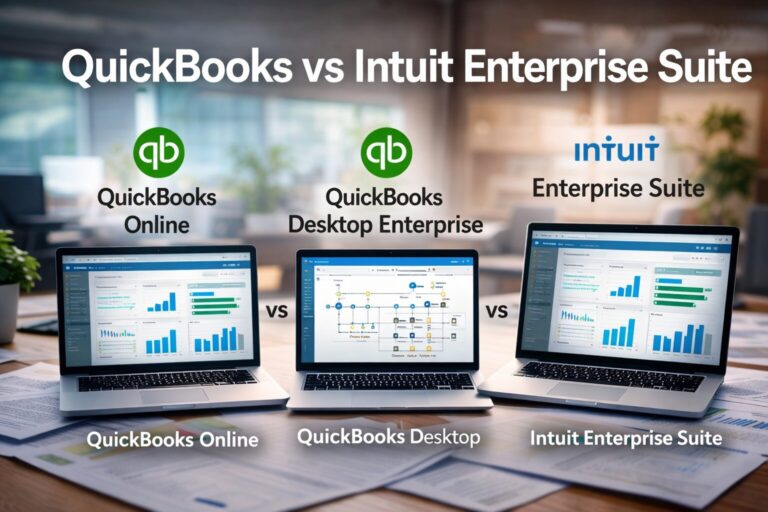
No. These are different products. QuickBooks Desktop Enterprise is a locally installed application with expanded capacity over QBO but a similar single-entity architecture. Intuit Enterprise Suite is a cloud-based platform with native multi-entity management, AI-driven financial tools, and a reporting structure designed for organizational complexity. The two products serve different use cases.
What does Intuit Enterprise Suite cost?
Intuit does not publish standard pricing for IES on its website. Pricing is customized based on the number of entities, users, and features required. Peak Advisers can facilitate a pricing conversation as part of an initial assessment.
The Right System for the Business You Are Building
QuickBooks Online is not the wrong tool. It is a purpose-built platform that serves millions of businesses effectively. The question is whether it is the right tool for the business as it exists now — and as it is heading.
When financial systems can’t keep pace with operational complexity, the gap doesn’t stay invisible for long. It shows up in slow reporting, manual workarounds, and decisions made on data that leadership doesn’t fully trust. That is not a people problem. It is a structural one.
If your business has grown to a point where the monthly close requires significant manual effort, consolidated reporting requires spreadsheet assembly, or intercompany transactions are being managed outside the system, the conversation is worth having before the next stage of growth makes it more complicated.
Peak Advisers works with businesses at exactly this inflection point. If you want an honest assessment of whether your current financial structure matches where your business is going, that is the conversation we are built for.