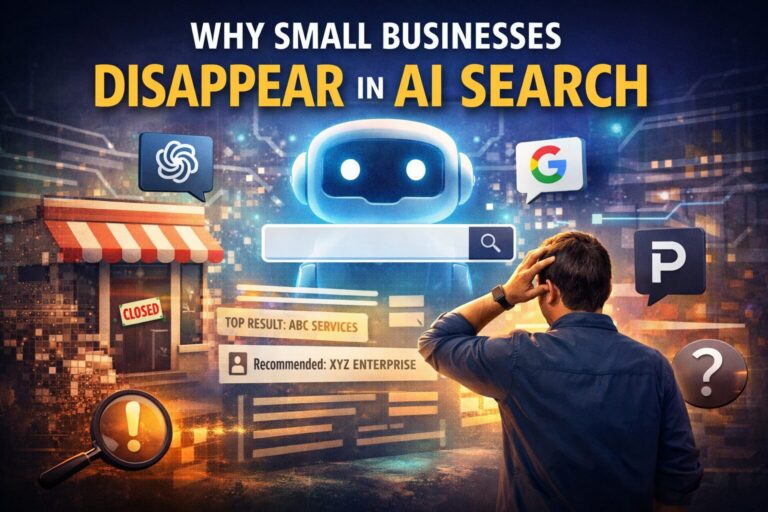

Not long ago, showing up online meant one thing: ranking on Google’s first page. You wrote good content, kept your website updated, and if you did the work consistently, customers found you. That model still matters — but small business AI search visibility now depends on something more. AI tools are answering your customers’ questions directly, often before they ever see a single website link.
When someone types a question into Google today, they often see an AI-generated summary at the top of the page before they see a single website link. When they ask ChatGPT, Perplexity, or Google’s Gemini where to find a QuickBooks consultant, a local plumber, or a marketing specialist, the AI answers directly — sometimes without sending the user to any website at all.
This shift is called AI search. And for small businesses, it’s the most important change to how customers find you since Google itself launched.
The businesses that understand it are gaining visibility. The ones that don’t are watching their traffic quietly erode — and wondering why.
What AI Search Actually Is
Traditional search works like an index. You search, Google shows you a list of links ranked by relevance, and you click the one that looks most useful.
AI search works differently. Instead of showing you links, AI tools — Google’s AI Overview, ChatGPT, Perplexity, Gemini, Copilot — read the web and generate a direct answer. They pull from multiple sources, synthesize the information, and give the user a response. Sometimes they cite sources. Often they don’t send users anywhere at all.
For businesses that relied on people clicking through to their websites, this creates a real problem. When a Google AI Overview is present, click-through rates on traditional links drop significantly. Zero-click searches — where someone gets their answer and moves on without visiting any site — now make up the majority of all Google queries.
For small businesses, this can feel alarming. It doesn’t have to be.
Why Small Businesses Actually Have an Advantage Here
Here’s what most coverage of AI search misses: AI systems don’t favor the biggest brands. They favor the most relevant, clear, and trustworthy sources for a given question.
Large brands have broad content but rarely deep local or niche expertise. A small business that clearly explains exactly what it does, who it serves, and where it operates is often more useful to an AI system answering a specific question than a Fortune 500 company’s generic service page.
When someone asks ChatGPT “who can help me clean up my QuickBooks in Denver” or “best fractional CFO for small business in Naples,” the AI is looking for businesses that specifically and credibly answer that need. That’s a small business advantage — if the content and signals are in place.
The businesses winning in AI search right now aren’t the ones with the biggest budgets. They’re the ones whose websites clearly, specifically, and credibly communicate what they do.
SEO Still Works — AI Search Visibility Builds on Top of It
Before getting into what’s new, it’s worth being direct about what hasn’t changed. The SEO fundamentals that have always driven visibility — well-written content, a fast and mobile-friendly website, quality backlinks, accurate business listings, and a strong Google Business Profile — are still essential. AI search doesn’t replace those. It layers on top of them. Businesses with a solid SEO foundation are the ones best positioned to also win AI search visibility, because both reward the same core things: relevance, clarity, and credibility.
The Five Things That Determine Whether AI Finds — and Cites — Your Business
1. Clear, Specific Content That Directly Answers Questions
AI search engines are built to answer questions. They surface content that answers those questions clearly and directly — not content that talks around a topic or uses vague marketing language.
Every service page and blog post on your website should answer specific questions your customers are actually asking. Not “We offer comprehensive financial solutions” — but “We help small businesses in Denver set up and clean up QuickBooks so their books are accurate and their reporting makes sense.”
The more specifically your content matches what someone is searching for, the more likely an AI system is to pull from it when generating an answer.
2. Structured Content That AI Can Read Easily
AI systems don’t read websites the way humans do. They scan for structure — clear headings, organized sections, bullet points, and well-labeled information. Content buried in long paragraphs, using inconsistent formatting, or lacking clear section breaks is harder for AI to extract and use.
Best practices that help AI read your content:
- Use descriptive H2 and H3 headings that reflect actual search questions
- Break information into concise, scannable sections
- Use bullet lists for features, steps, and comparisons
- Keep one main idea per paragraph
- Avoid jargon and filler language that obscures the actual point
This is also just good writing. Content that’s easy for AI to read is almost always easier for humans to read too.
3. FAQ Sections on Every Important Page
FAQ sections are one of the most direct ways to improve AI search visibility — and one of the most overlooked.
When an AI system encounters a well-structured FAQ, it sees a ready-made set of questions and direct answers. That’s exactly what it’s looking for when someone asks it something. Service pages and blog posts with FAQ sections are significantly more likely to be cited in AI-generated responses than pages without them.
Every service page on your website should have a FAQ section. So should your most important blog posts. The questions should reflect what customers actually ask — not what you wish they’d ask.
4. Schema Markup
Schema markup is code added to your website that tells search engines and AI systems exactly what your content is about. It’s not visible to readers, but it’s highly visible to the AI tools crawling your site.
For small businesses, the most important schema types are:
- LocalBusiness or Organization schema — establishes who you are, where you’re located, and what you do
- Service schema — identifies each specific service you offer
- FAQ schema — marks up your FAQ sections so AI systems recognize them as direct question-and-answer content
- Article schema — applied to blog posts to help AI understand the content type and authority
Without schema markup, AI systems have to guess at your content’s context. With it, you’re telling them directly. That difference shows up in whether or not you get cited.
5. Consistent Business Information Everywhere
AI systems build trust in a business by cross-referencing information across the web. Your name, address, phone number, and service descriptions should be identical across your website, Google Business Profile, industry directories, and any other platform where your business appears.
Inconsistencies — a different phone number here, a slightly different business name there — signal to AI systems that the information is unreliable. Consistent information across every platform signals trustworthiness. That trust directly influences whether AI tools cite you or skip you.
What Happens If You Don’t Show Up in AI Search
The shift to AI search is not a future concern. It’s happening now, and it’s accelerating.
40% of small businesses have already reported traffic disruption from AI search changes. The businesses feeling it most are the ones whose visibility depended entirely on traditional Google rankings — without the content structure, schema markup, or clear messaging that AI systems need to understand and surface them.
The businesses least affected are those that already had strong, clear, well-structured content — because that content works for both traditional SEO and AI search. The two approaches are not in conflict. AI search rewards the same fundamentals that have always made content good: clarity, specificity, usefulness, and honesty.
Building AI Search Visibility: A Practical Starting Point
The practical starting point for most small businesses looks like this:
- Audit your service pages — are they specific, clear, and written to answer actual customer questions? Or are they vague and marketing-heavy?
- Add FAQ sections to your most important service pages and blog posts
- Check your schema markup — most small business websites have none, or only basic organization markup
- Verify your Google Business Profile is complete, accurate, and regularly updated
- Ensure consistency — your business name, address, phone number, and service descriptions should match everywhere they appear online
- Publish content regularly — AI systems favor fresh, active websites over static ones
None of these steps require a large budget. They require the right knowledge and consistent execution.
Learn how Peak Advisers’ AI-powered SEO and blog writing services are built for exactly this
The Difference Between Showing Up and Being Invisible
In traditional search, being on page two of Google meant fewer people found you. In AI search, there is no page two. AI tools generate one answer. Either your business is part of it, or it isn’t.
That’s a sharper line than most small business owners have had to contend with before. It also means that the businesses that get this right early have a meaningful, compounding advantage over competitors who haven’t caught up yet.
The fundamentals aren’t complicated. Clear content, good structure, consistent information, and the right technical signals. What makes the difference is whether those things are actually in place — and whether someone is actively maintaining and improving them.
Peak Advisers helps small businesses build the content and technical foundation to show up in AI search, traditional Google, and everywhere in between. Schedule a free consultation.
Additional Resources
Small business digital marketing is eating your time and budget
See how SEO-optimized blog writing builds AI search visibility over time
Learn how the QuickBooks Bank Feed post is built for AI search structure
Peak Advisers LLC provides AI-powered SEO, blog writing, and digital marketing services built specifically for small businesses. Based in Colorado and Florida, we help businesses get found — in Google, in AI search, and everywhere in between.
Frequently Asked Questions
What is AI search and how is it different from regular Google?
Traditional Google search shows you a ranked list of website links. AI search tools — including Google’s AI Overview, ChatGPT, Perplexity, and Gemini — generate a direct answer to your question by scanning and synthesizing content from across the web. Users often get their answer without clicking any website at all. For businesses, this means visibility now requires being cited in AI-generated answers, not just ranking in traditional results.
Can small businesses actually compete with large brands in AI search?
Yes — and in many cases, small businesses have an advantage. AI search systems prioritize relevance and specificity over brand size. A small business that clearly and credibly describes exactly what it does and who it serves often outperforms a large brand’s generic content for specific, local, or niche queries.
What is GEO and how is it different from SEO?
SEO (Search Engine Optimization) focuses on ranking in traditional search results through keywords, backlinks, and technical site quality. GEO (Generative Engine Optimization) is the practice of structuring your content and digital presence so AI-powered search tools can understand, trust, and cite you when generating answers. The two approaches overlap significantly — strong SEO provides a foundation for GEO — but GEO adds specific practices like FAQ sections, schema markup, and content structured around direct questions and answers.
How long does it take to show up in AI search results?
There’s no set timeline, and AI search citations aren’t guaranteed the way traditional rankings can be tracked. However, businesses that implement clear content structure, FAQ sections, schema markup, and consistent business information typically see meaningful improvement in AI visibility within 60 to 90 days. Content that directly answers specific questions your customers ask tends to gain traction fastest.
Do I need a big budget to optimize for AI search?
No. Most of the foundational work — clarifying your service page content, adding FAQ sections, verifying your Google Business Profile, and ensuring consistent business information — doesn’t require significant spend. Schema markup implementation has a modest one-time cost if done professionally. The ongoing investment is primarily consistent content creation and maintenance, which delivers compounding returns over time.