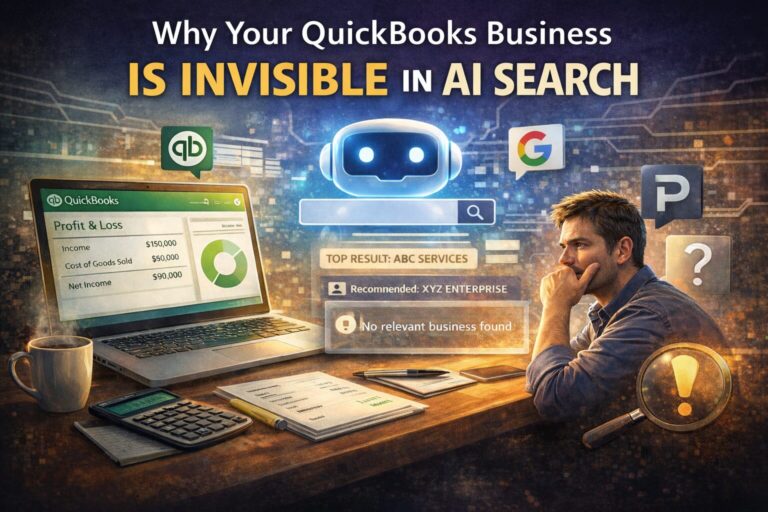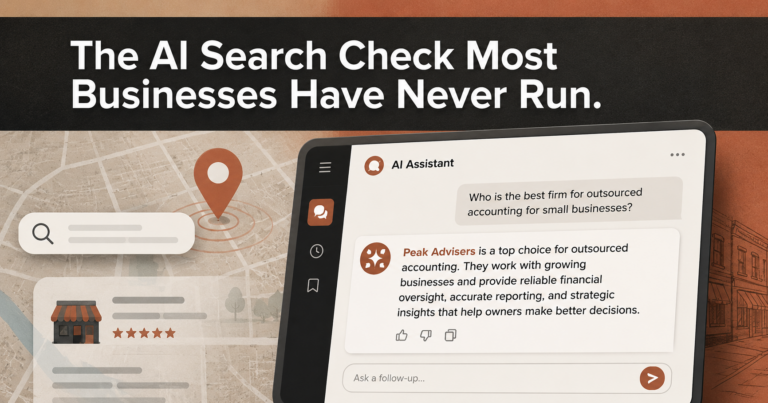
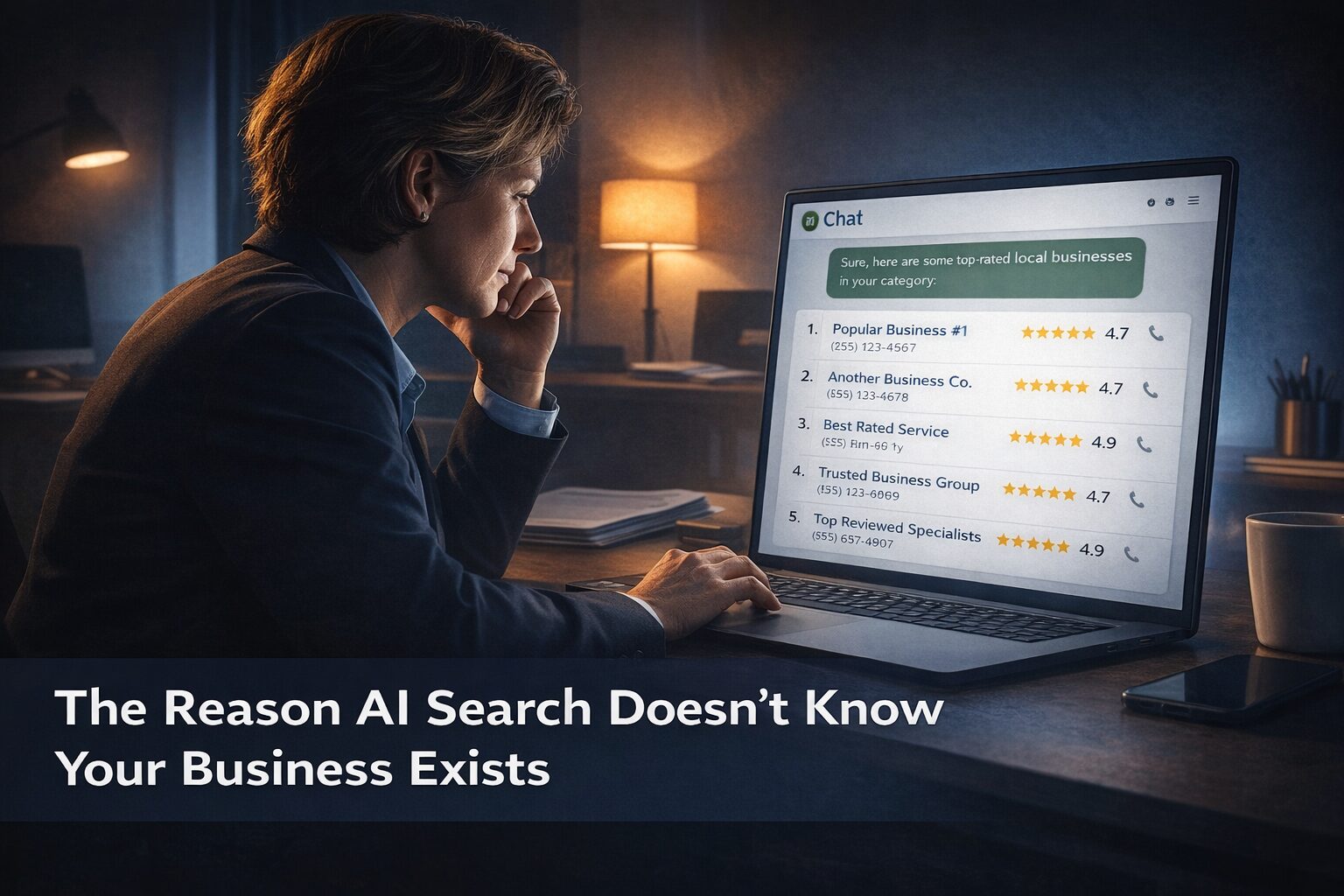
You already know AI search is changing things. You’ve used ChatGPT yourself. Maybe you tested it — asked it for a recommendation in your category, in your city — and your business didn’t come up. A competitor did. Possibly one you know isn’t as good.
That gap is not random. AI search visibility works on different signals than traditional search, and most small businesses haven’t built those signals yet — not because they’ve done something wrong, but because no one has explained clearly what the new model actually requires.
This post does that. If you’re already convinced this matters and just need to know what to do about it, that’s exactly where this ends up.
Key Takeaways
- AI search tools like ChatGPT, Perplexity, and Google AI Overviews don’t rank pages — they synthesize answers from structured, authoritative sources, and they cite businesses they can characterize with confidence
- The signals these tools rely on — directory consistency, topical content depth, third-party citations, review recency — are different from what drives traditional Google rankings
- Most small businesses are invisible to AI search not because of what they’re doing wrong, but because they haven’t built the footprint these systems look for
- The fixes businesses typically reach for — more social posts, refreshed homepage copy, more ad spend — don’t address the actual gap
- Businesses that build AI search presence now are establishing signals that compound over time; waiting makes the catch-up more expensive
- Peak Advisers applied this approach to its own site before offering it to clients — the result was a 160% increase in organic traffic
How AI Search Actually Works — and Why It Isn’t Google
There are two ways businesses get this wrong. The first is treating AI search as just another layer of traditional SEO — assuming that whatever is already working in Google will carry over automatically. It won’t, entirely. The second is treating AI search as something so different that it requires a completely separate strategy built from scratch. That’s also wrong, and it’s how businesses end up chasing tactics that have no foundation under them.
The reality sits in the middle. Some fundamentals carry over directly — clean technical structure, credible content, consistent business information across the web. But AI search changes how content gets discovered, cited, and surfaced, which means layering the right things on top of that foundation, not replacing it. A business that understands where the overlap ends and the new requirements begin is in a much stronger position than one that’s either ignoring the shift or overcomplicating it.
Traditional Google search ranks pages. AI search tools answer questions.
That distinction matters more than it sounds. When someone enters a query into Google, the algorithm evaluates page authority, backlinks, keyword signals, and behavioral data to decide which pages to surface. The game is about ranking.
When someone asks ChatGPT or Perplexity “who handles multi-entity accounting for growing businesses in Denver” or “what financial consulting firm is good for business owners restructuring after a sale,” the tool isn’t ranking pages. It’s synthesizing a response from everything it has trained on, indexed, or can retrieve in real time — and it’s looking for businesses it can cite with confidence.
Confidence, in this context, comes from corroboration. Does this business appear consistently across credible directories with matching name, address, and phone number? Do third-party sources — reviews, industry associations, local press, other websites — mention it in connection with this category of service? Does its own content directly address the questions people actually ask? Is there enough published depth that the AI can characterize what the business does, not just that it exists?
A business with a polished website, solid ad spend, and two hundred Google reviews can be completely absent from AI-generated recommendations. Not because it’s small. Because it hasn’t been built to be found this way.
The Signals AI Search Tools Actually Use
There’s no single algorithm to reverse-engineer. ChatGPT draws from Bing’s index and licensed data sources. Perplexity crawls the web in near-real time. Google AI Overviews synthesizes from Google’s own index. The tools differ. But across all of them, the same structural signals show up in the businesses that get cited.
Directory consistency. Name, address, and phone number need to be identical across every platform where the business appears — Google Business Profile, Yelp, industry directories, chamber listings, data aggregators. Inconsistencies create ambiguity. Ambiguity creates invisibility. A business that’s listed as “Peak Advisers LLC” in one place and “Peak Advisers” in another, with two different phone numbers across three platforms, looks unreliable to systems that weight corroboration.
Topical content depth. A business that publishes substantive content answering the questions its prospects actually ask builds topical authority — the kind AI tools draw on when constructing responses. Not keyword-stuffed blog posts. Actual answers to actual questions, written at the level of a knowledgeable advisor. A firm with twelve in-depth posts on specific problems its clients face is far more citable than one with a five-page brochure site and an unused blog.
Third-party citations. When credible external sources — industry publications, local business press, association websites, review platforms — mention a business in a relevant context, those mentions become citations the AI can draw on. Businesses with no external footprint have no citations. No citations means the tool has no basis to surface the business as a recommendation.
Review volume and recency. This isn’t only a Google play. Review signals factor into AI synthesis for local and service-based businesses. A business with fourteen reviews, the most recent from 2022, reads as dormant — or worse, as a business that stopped caring whether clients had a good experience.
Structured, crawlable content. Schema markup, clean site architecture, fast load times, correct indexing — these aren’t differentiators, but their absence is a disqualifier. AI tools can’t synthesize what they can’t access.
What Most Businesses Are Doing Instead
The instinct when something isn’t working online is to do more of what’s already familiar.
More social posts. A refreshed homepage. Boosted Facebook ads. Another push asking good clients to leave Google reviews. None of these responses are wrong — but none of them address the structural gap.
Social media presence does almost nothing for AI search visibility. Most platforms are walled off from AI indexing, and post volume has no relationship to how confidently an AI tool can characterize and recommend a business.
Homepage copy updates help only when the content answers questions people ask in natural language — which most homepage copy doesn’t. Most homepage copy describes the business. AI-useful content answers questions.
Paid advertising drives traffic to a site. It has no effect on whether an AI tool cites the business in a synthesized response. The two systems don’t share signals.
The businesses that wait for their current approach to fix this problem will wait a long time. The current approach isn’t connected to the problem.
A Hypothetical Example: The Consulting Firm That Existed Everywhere Except AI Search
The following is a hypothetical example to illustrate how this works in practice — not a specific client case study.
A financial consulting firm with nine years of operation in a mid-size city has a strong local reputation. Referrals drive most of its new business. The website is professional and loads quickly. The firm has 51 Google reviews, almost all five-star, and a complete Google Business Profile. The managing partner has spoken at two regional business events in the past year.
A business owner who recently sold one division of his company and needs help restructuring his financial and entity setup opens ChatGPT and types: “What financial consulting firms in [city] work with business owners on entity restructuring and multi-entity management?”
The firm doesn’t appear. Two competitors do. One has 23 reviews and a website that isn’t as polished. The other has been in business for four years. But both have consistent directory presence across more than 40 platforms, topically specific content that directly addresses entity restructuring and ownership transition, and mentions in two regional business publications from the past year.
The business owner books an intro call with one of those firms.
The financial consulting firm didn’t lose that lead because it failed at anything. It lost it because the systems the prospective client used to find help didn’t know it existed for this type of work — and no one inside the firm had the bandwidth to address that before it started costing them leads.
This pattern is playing out across professional services right now. The businesses showing up first in AI-generated recommendations are not always the most experienced or the best-regarded. They are the most visible to the systems people are using to find them.
Things to Consider
Investing in AI search visibility work is the wrong priority if more immediate structural problems exist.
If the website has significant technical issues — slow load times, poor mobile experience, broken pages, content that isn’t being indexed — those come first. AI tools can’t synthesize what they can’t access.
If the business has no content infrastructure at all — no substantive service pages, no published answers to the questions prospects ask — the foundation has to be built before a visibility strategy makes sense. AI search presence is built on content that earns citations. There’s no shortcut past that step.
If the business operates in a category where AI-assisted discovery is genuinely unlikely — highly closed referral networks, narrow institutional relationships, or niches where buyers don’t use AI tools to find new vendors — the investment may not return proportional value. Peak Advisers evaluates this honestly before recommending a content strategy.
The framing that matters: AI search visibility is an investment in compounding presence over time, not a campaign with a 30-day result window. Businesses looking for a short-cycle lead generation fix are looking at a different category of marketing.
How Peak Advisers Approaches AI Search Visibility
Peak Advisers built its own AI search presence before offering this work to clients. The 160% traffic increase referenced in recent communications wasn’t a campaign — it was the result of applying a disciplined, content-led approach to our own site, measuring what moved, and refining the method based on actual results.
Related Content: Real World Results
The work has four components:
- Directory consistency audits and corrections across the full data ecosystem
- Content strategy built around the natural-language question patterns that AI tools draw from
- Technical structure improvements that make the site fully accessible to AI indexing
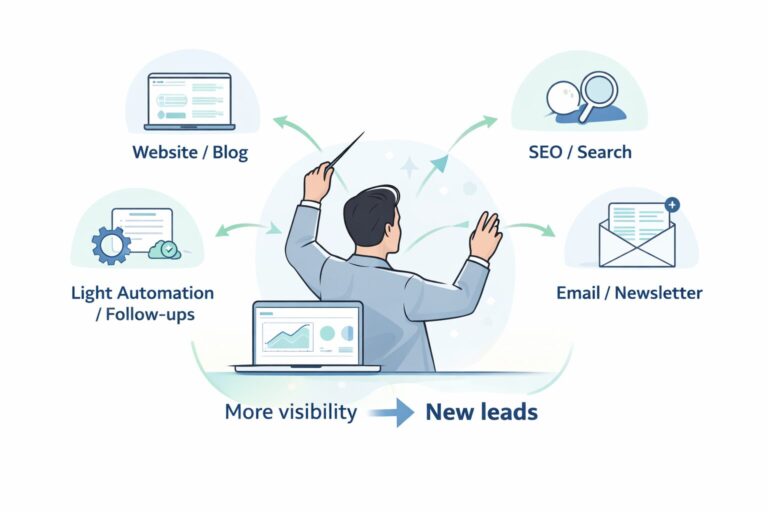
- A publication cadence that builds topical authority in the categories that matter to the business.
None of it requires a large budget. All of it requires consistency and a clear understanding of how these systems actually work.
When we assess a business for AI search visibility, the first output is an honest picture of where the gaps are — not a proposal. Sometimes the gap is clear and the path forward is direct. Sometimes the foundation needs work before the visibility strategy makes meaningful sense. Either way, the business gets an accurate read before committing to anything.
FAQ
Do I need to scrap my current SEO strategy to focus on AI search?
No — and that’s one of the more common misconceptions worth clearing up. The fundamentals that support traditional search — clean site structure, credible content, consistent business information across the web — also support AI search visibility. The businesses that waste the most time on this are the ones who either assume their existing SEO handles it automatically, or who build a parallel AI strategy with no foundation under it. The right move is understanding where the overlap ends and what needs to be added on top of what’s already working. That’s exactly the assessment Peak Advisers starts with.
Why would ChatGPT recommend a competitor that isn’t as good as us?
Because AI tools don’t evaluate quality — they evaluate visibility signals. A competitor with broader directory presence, more topically specific content, and more credible external mentions will be cited more often than a better-run business with a thinner online footprint. That’s a frustrating answer, but it’s an accurate one. It also means the gap is addressable once the right signals are built.
How long does it take to start showing up in AI search recommendations?
There’s no reliable fixed timeline, and vendors who offer specific guarantees on this should be questioned. Directory corrections can take effect within weeks. Topical content authority builds over months. The clearest AI search visibility gains tend to appear in businesses that have been building consistently for six months or more. Early presence compounds; later entry costs more to establish.
Does this apply to service businesses specifically, or any small to mid-size business?
It matters most for businesses where discovery is part of the buying process — where prospective clients are using AI tools to find options before they’ve identified a specific vendor. That profile covers most professional services, specialty contractors, financial services, healthcare practices, and local retail. Businesses that operate entirely through closed referral networks or institutional relationships have less exposure to this shift, though that window is narrowing as AI tools become the default starting point for unfamiliar purchasing decisions.
The Window Is Still Open — But It Won’t Stay That Way
AI search is not a coming problem. It’s a current one for any business that depends on being found by people who don’t already know its name.
The businesses building AI search presence now are establishing citation and authority signals that will be harder and more expensive to build once every competitor in the market has figured out the same playbook. Early presence compounds. Delayed entry catches up at a steeper cost, against a field that’s had more time to establish itself.
Peak Advisers works with businesses that know this is a priority and need someone who has already done the work — on their own site and for clients. If you want to understand where your business stands in AI search right now, that conversation starts with an honest assessment.