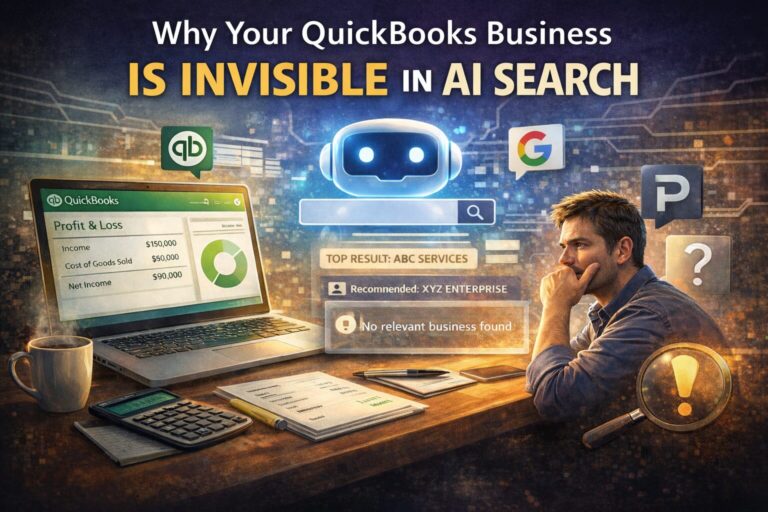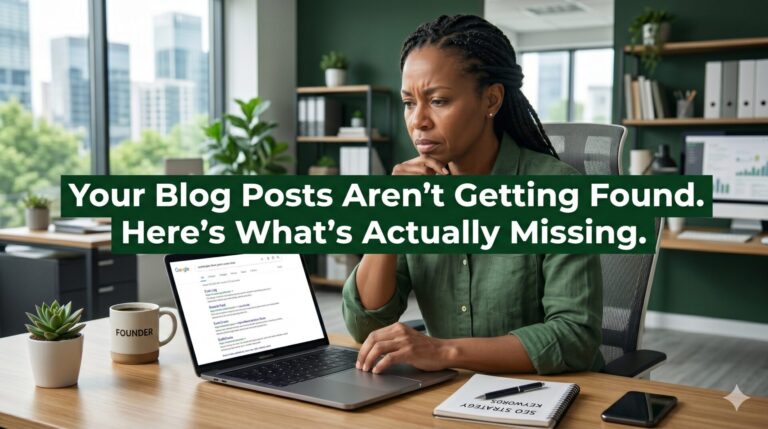
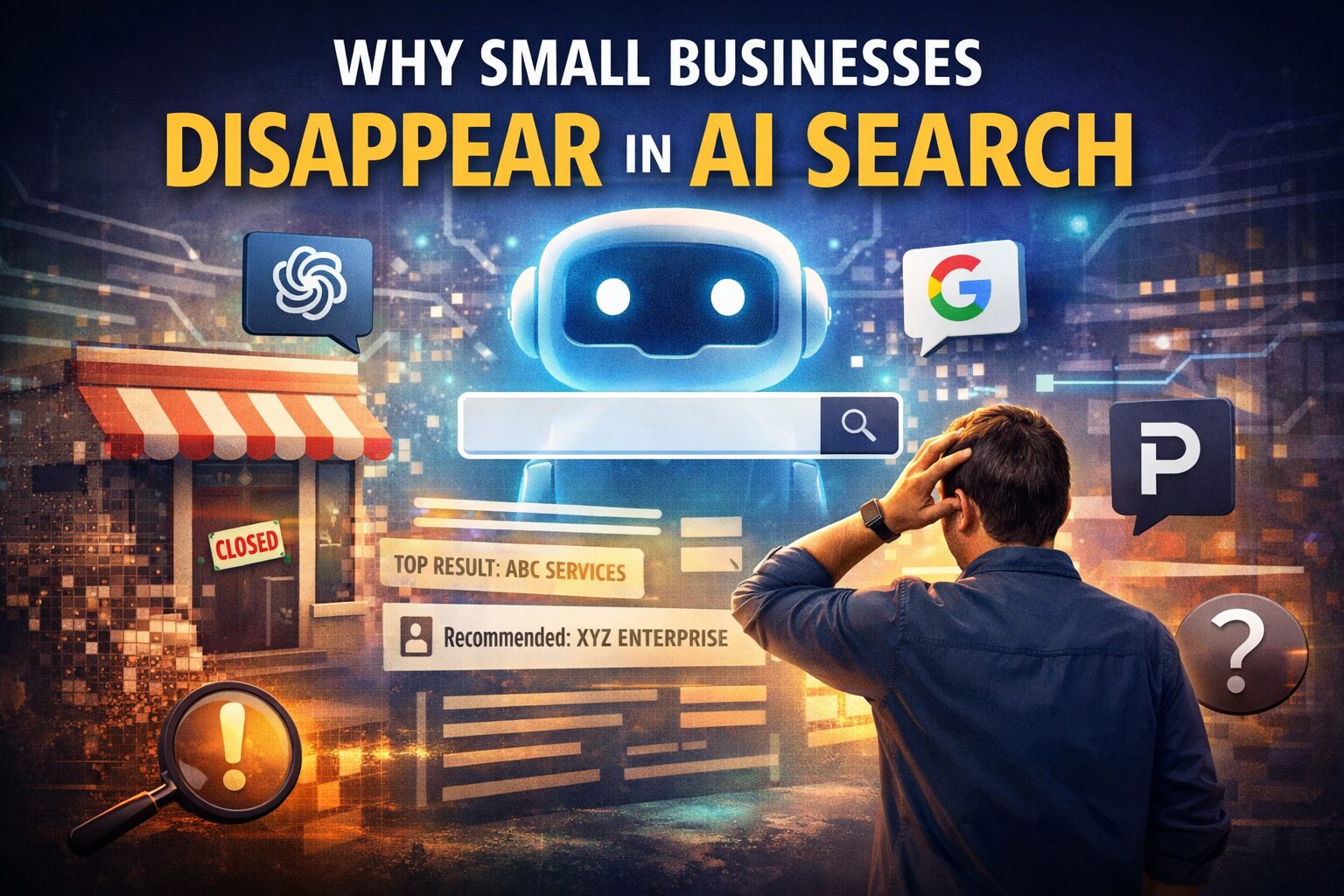
Your business exists. Your website is live. You have done the work, served real customers, and earned real results. So why — when a potential customer types a question into ChatGPT, Perplexity, or Google AI Overviews — does your competitor’s name come up and yours does not?
This is not a visibility problem that fixes itself. And it is not solved by posting more on Instagram or paying someone to run ads. What is happening is structural — and the businesses that understand it now are quietly pulling ahead of everyone still waiting to “see how AI search plays out.”
This piece explains exactly why small business AI search visibility breaks down, what the failure patterns look like, and what a realistic fix actually requires.
Key Takeaways
- AI search tools — ChatGPT, Perplexity, Google AI Overviews — now answer customer questions directly, bypassing websites with thin or unstructured content.
- Small businesses disappear in AI search for three specific, fixable reasons: no structured content, no consistent entity signals, and no published expertise.
- Generic AI-generated blogs and sporadic social posts do not build the citation authority AI systems look for.
- Businesses that grew their AI search visibility did so with consistent, structured, expert-authored content — not by gaming an algorithm.
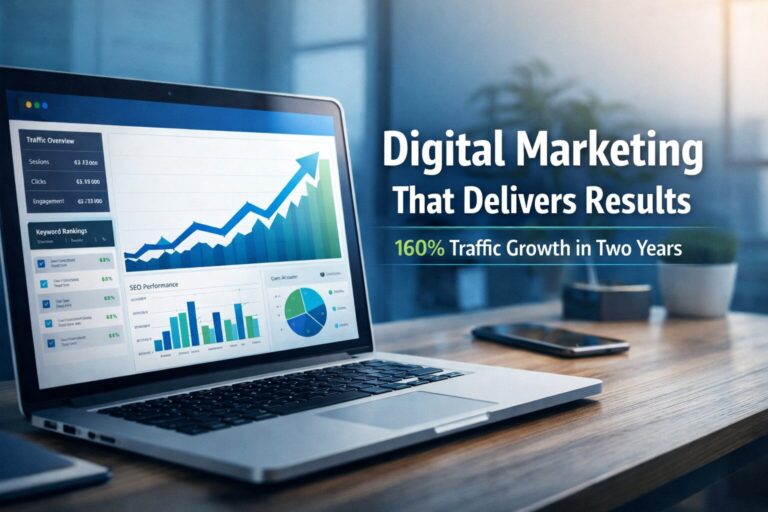
- Peak Advisers grew its own web traffic 160% in twelve months by applying the same approach it uses for clients.
How AI Search Actually Works — and Why Most Small Business Websites Fail It
Traditional search engines ranked pages. AI search tools read pages, extract meaning, and synthesize answers. The distinction matters more than most business owners realize.
When someone asks ChatGPT “What is the best bookkeeping service for a small construction company in Denver?” the AI does not return a list of links. It generates a direct answer — and to do that, it pulls from content it has indexed, trusted, and found specific enough to cite. Vague content gets ignored. Generic “About Us” pages get ignored. A website that has not published anything new since 2022 gets ignored.
The businesses that appear in those AI-generated answers share specific content characteristics: clear service descriptions, published FAQ content, original data or case results, and consistent mentions across third-party sources. Most small businesses have none of these.
That is the structural gap. Not a lack of budget. Not a lack of effort. A lack of the right kind of content, published consistently, in a format AI tools can actually use.
Three Failure Patterns That Kill Small Business AI Search Visibility
After working with small and mid-size businesses, we see the same three breakdowns repeat:
Failure Pattern 1: Content That Exists but Doesn’t Answer Anything
The website has a services page. It lists what the business does. But it does not answer the questions customers are actually asking — “How long does it take?” “What does it cost?” “Who is this for?” “What happens if I call?”
AI tools are answer engines. If your content does not contain answers, it does not get cited. A paragraph describing your services in broad terms is not a citable answer. A 300-word FAQ that says “we offer competitive pricing” is not a citable answer. Specificity is the entry fee.
Failure Pattern 2: No Published Track Record
Businesses that show up in AI search have something published that proves they know what they are talking about. A blog post with a real client scenario. A newsletter that walks through a common problem. A before-and-after case result with actual numbers.
Most small business owners stop here because publishing consistently feels like a full-time job on top of running the business. That hesitation is understandable. It is also the exact reason their competitors are getting cited and they are not.
Failure Pattern 3: Invisible Outside Their Own Website
One of the most consistent findings in AI citation research: businesses are significantly more likely to be cited through third-party sources than through their own domain alone. That means Google Business Profile, industry directories, published press mentions, partner websites, and review platforms all contribute to whether an AI system trusts a business enough to mention it.
A business with a clean website but no external footprint looks thin to an AI system. The information is not corroborated anywhere else. In a world where AI tools are trying to surface trustworthy answers, unverified businesses get filtered out.
What This Looks Like in Practice: A Scenario
A commercial cleaning company in metro Denver has been in business for nine years. Strong referral network. Solid Google reviews. A professional-looking website built in 2021 that has not been touched since.
A facilities manager at a mid-size office building asks ChatGPT: “What should I look for in a commercial cleaning service for a 20,000 square foot office space in Denver?”
The AI returns a detailed answer — what to ask about staffing ratios, insurance requirements, green cleaning certifications, contract terms. It cites three sources. None of them are the cleaning company.
Two of the cited sources are competitors who published blog content in 2025 answering exactly those questions. One is an industry trade publication.
The cleaning company’s nine years of experience — and the fact that they do everything the AI described — is nowhere in the answer. Because they never published it.
What Actually Builds Small Business AI Search Visibility
The businesses gaining ground in AI search are not doing anything exotic. They are doing the basics at a higher standard and more consistently than their competitors. Specifically:
Publishing structured content regularly. One to two well-constructed blog posts per month, built around the specific questions their target customers ask. Not keyword-stuffed. Not AI-generated filler. Actual answers written by people who know the work.
Building FAQ sections that mirror real customer language. Not “What are your services?” but “Do you work with businesses that use QuickBooks Online?” or “How long does a typical bookkeeping cleanup take?” These are the exact queries showing up in AI search.
Creating a consistent external footprint. Updated Google Business Profile. Accurate listings in relevant directories. Published case results or client outcomes — even simple ones — that appear in places other than the business’s own website.
Using original data when possible. Research shows pages with original data earn significantly more AI citations than pages that only repeat information found elsewhere. Even a simple stat — “We have logged more than 30,000 hours working inside QuickBooks environments since 2011” — is original data. Use it.
Peak Advisers applied this approach to its own digital marketing services. The result: 160% growth in web traffic in twelve months (Google Analytics, March 2025). The same methodology is what we build for clients.
When This Is the Wrong Move
Not every business should invest in AI search visibility right now. There are situations where this work is premature — or where a different approach makes more sense.
- Your offer, pricing, or target customer is still undefined. Publishing content before that clarity exists produces traffic that does not convert. Fix the business model first.
- You are expecting results in 30 days. AI search citation authority builds over months, not weeks. If your situation requires immediate leads, paid search is a faster tool for that specific job.
- You want a one-time content drop. Publishing ten blog posts in a single month and then going dark for six months is worse than publishing one post per month consistently. AI systems favor freshness and sustained publishing cadence.
- You need enterprise-scale content infrastructure. If you are managing multiple locations, a large sales team, or complex regulatory content requirements, you are past the scope of what a small business content partner handles well. That is a different engagement.
If none of those apply — if you run a real small business with a clear offer, you have been at it for a while, and customers who find you tend to hire you — then the gap between where you are and where you should be in AI search is a fixable content problem.
How Peak Advisers Approaches This for Clients
Most of our clients come in saying the same thing: “I know content matters. I just don’t have time to do it, and I don’t trust that the last agency I paid actually understood my business.”
We are not a content factory. We are not a team of generalists who produce volume. We have decades of combined experience in journalism, financial systems, and digital marketing strategy — and we work with a limited number of clients at a time so the work stays sharp.
What we build is not generic. It reflects the specific language of your business, the real questions your customers ask, and the credibility markers that AI systems look for when deciding what to cite.
The result is content that works in traditional search and in AI search — because the underlying quality standard is the same for both.
If you want to see where your business stands — and what it would take to close the visibility gap — start with a free consultation. Review our digital marketing services or call to schedule a conversation.
FAQ: Small Business AI Search Visibility
Do small businesses still need SEO now that AI search tools are answering questions directly?
SEO is not dead — but the version of it that most small businesses were sold is no longer enough on its own. Getting your pages to rank in a list of blue links still matters. But it no longer guarantees visibility when a customer asks ChatGPT, Google, or Perplexity for a recommendation and gets a direct answer with no links at all. The businesses winning right now are treating traditional SEO and AI search optimization as two parts of the same strategy — not choosing one over the other. Strong technical SEO, consistent publishing, and structured content built around real customer questions serves both. Businesses that abandon SEO entirely in favor of chasing AI citations, or that ignore AI search entirely while clinging to 2019 SEO tactics, are losing ground from both directions.
What is AI search visibility for small businesses?
AI search visibility refers to whether your business appears — by name, recommendation, or citation — when AI tools like ChatGPT, Perplexity, Google AI Overviews, or Microsoft Copilot generate answers to questions your potential customers are asking. It is separate from traditional Google rankings, though the two overlap. Businesses with structured, specific, regularly updated content earn more AI citations.
How long does it take to show up in AI search results?
There is no guaranteed timeline, and anyone who gives you one is guessing. In practice, businesses that publish structured, specific content consistently begin seeing citation appearances within three to six months. The businesses with the fastest results combine publishing with updated Google Business Profiles, relevant directory listings, and external mentions on third-party sites.
Does posting on social media help with AI search visibility?
Marginally, and mostly indirectly. Social media posts are ephemeral — they are not indexed by AI systems the way structured website content and blog posts are. Active social accounts contribute to brand signal consistency, which AI systems use as a trust indicator. But posting on Instagram is not a substitute for published, structured content on your own domain.
What does Peak Advisers do to help small businesses with AI search visibility?
We research, write, edit, and publish SEO-structured blog content, email newsletters, and supporting digital content for small businesses who do not have the internal resources to do it themselves. We handle strategy, execution, and ongoing optimization — so the business owner gets the results without spending their evenings writing blog posts. See more here.