
Your books are clean. Your QuickBooks is set up correctly — or close enough that you trust the numbers. You know your margins. You can pull a P&L without panic. You have built the financial discipline that most small business owners never get around to.
So why, when a potential customer asks ChatGPT or Google for a recommendation in your category, does a competitor with a fraction of your operational discipline show up — and you don’t?
Because getting found online and managing clean financials are two completely separate problems. And most small business owners who have solved the first one have never touched the second.
Key Takeaways
- A well-managed QuickBooks file and a visible digital presence have nothing to do with each other — one does not produce the other.
- AI search tools cite businesses that have published structured, specific content. They cannot cite what they cannot find.
- The same systems thinking that produces clean financials applies directly to content publishing — and almost no one is applying it.
- Referrals and social media posts do not build the indexed content footprint that AI search requires.
- Peak Advisers works specifically with small businesses to close this gap — without the business owner writing a single word.
Why Getting Found Online Has Nothing to Do With Your QuickBooks
There is a version of a small business that looks excellent from the inside and nearly invisible from the outside.
The owner knows their numbers. QuickBooks is reconciled monthly. Job costing is accurate. The accountant is happy. The bank relationship is solid. From an operational standpoint, this business is running the way a small business is supposed to run.
From a digital standpoint, the website has not been updated since the business got its first decent customer. The blog has two posts, both from 2021. The Google Business Profile has a phone number that changed eighteen months ago. There is no published content that answers the questions potential customers are actually asking.
When an AI tool tries to surface this business in response to a relevant customer query, it finds almost nothing citable. So it moves on to the next result — which happens to belong to a competitor who published four blog posts last year and updated their FAQ section in January.
The financially disciplined business loses the visibility contest to the less disciplined one. Not because of anything wrong with their operation. Because they treated content publishing as optional.
See how Peak Advisers can help you with digital marketing.
Why Referrals Alone Stop Working
Referral-driven growth is real. For many small businesses it is the primary acquisition channel for years — sometimes decades. The problem is not that referrals stop working. The problem is that they plateau, and when they do, there is nothing else underneath them.
The ceiling on referral growth is fixed by the size of your existing network. The ceiling on search-driven growth — including AI search — is fixed by the quality and consistency of your published content. One scales with the work you put into it. The other does not.
The businesses that hit a referral plateau and never built a content presence find themselves invisible at exactly the moment they need new customers most. There is no published track record for AI tools to cite. There is no FAQ content for Google to surface. There is no blog post that answers the question a prospect just typed into their phone at 9pm.
By the time the problem is obvious, competitors who started publishing two years ago have a significant head start.
What This Looks Like in Practice: A Scenario
The following is a composite example based on the types of businesses we work with and the situations we see repeat across industries.
A residential HVAC contractor in metro Denver has operated for eleven years. Excellent reputation. Consistent five-star reviews. QuickBooks Online set up properly — job costing by service type, clean reconciliations, real reporting. The owner knows exactly where the business makes money and where it doesn’t.
Their website was built by a nephew in 2019. It lists services. It has a contact form. It has not been touched since.
A homeowner moves into a new house in Arvada and asks Perplexity: “What questions should I ask an HVAC contractor before signing a service agreement?”
Perplexity generates a detailed answer — what to ask about licensing, insurance, warranty terms, response times, and whether the company services the specific equipment brand in the home. It cites four sources. One is a national HVAC trade publication. Three are local or regional HVAC companies who published blog content answering exactly those questions.
The eleven-year contractor with the five-star reviews and the clean QuickBooks is not cited. They never published anything that answered those questions.
The homeowner calls one of the cited companies.
The Systems Thinking Problem
Here is the part most marketing conversations skip: the businesses that get content right are not more creative than the ones that don’t. They are more systematic.
A business that reconciles QuickBooks every month does it because they built a system — a scheduled habit with a clear output and someone accountable for it. The output is financial clarity. Without the system, the books get messy, decisions slow down, and tax season becomes a crisis.
Content publishing works exactly the same way. A business that publishes two blog posts per month does it because there is a system — a scheduled cadence, a clear format, someone accountable for the output. Without the system, nothing gets published, the website goes stale, and AI search tools have nothing to cite.
The owners who struggle with content are not struggling because they lack expertise. They are struggling because they are trying to produce content on top of running a business, without a system, without a format, and without anyone whose actual job it is. That is not a creativity problem. It is an operational problem — and operational problems have operational solutions.
When This Is the Wrong Move
Not every business should prioritize content marketing right now. A few situations where it makes sense to wait:
- Your referral pipeline is full and you are not looking to grow. If capacity is the constraint, not leads, adding a content marketing system before you can handle the volume it produces creates a different problem.
- Your offer, pricing, or target customer is still shifting. Publishing content before those are locked in produces traffic that does not convert and messaging that needs to be rebuilt anyway.
- You want results this quarter. Content builds citation authority over months, not weeks. If the business needs leads in the next 30 days, paid search is the right tool for that specific job.
If none of those apply — if you have built a real business, you know exactly who you serve, and you are watching competitors with less experience show up ahead of you in search — the gap is a content problem. It is also a solvable one.
How Peak Advisers Approaches This
We built Peak Advisers on more than 30,000 hours of hands-on QuickBooks and financial systems experience. We understand how small businesses actually operate — the operational discipline that goes into clean financials, the decisions that get made from solid reporting, the way a well-run business thinks about systems.
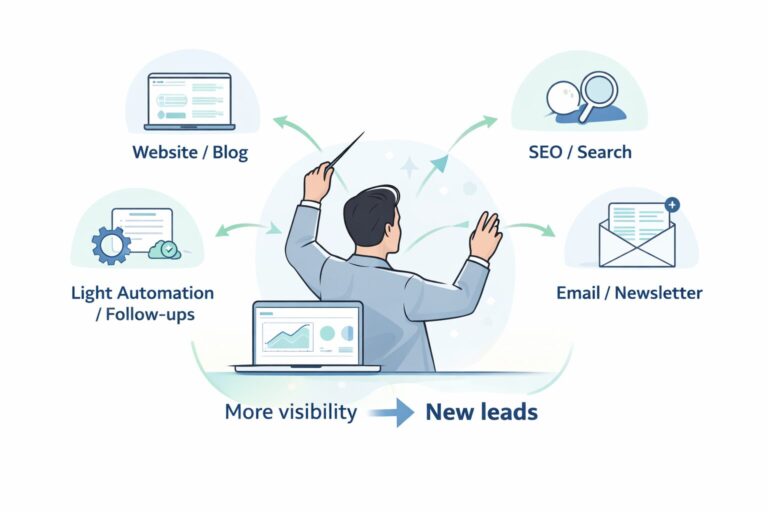
We brought that same thinking to digital content and marketing services. What we build for clients is not a pile of generic blog posts. It is a structured content system — consistent publishing cadence, real answers to real customer questions, SEO and AI search optimization built in from the start — that runs without the business owner spending their evenings writing.
The business owner keeps running the operation. We handle the content. The result is a growing published presence that AI tools can actually cite, traditional search can rank, and potential customers can find.
If you want to see what that looks like for your specific business, start with a free consultation.
Do small businesses still need SEO now that AI search tools are answering questions directly?
SEO is not dead — but the version of it that most small businesses were sold is no longer enough on its own. Getting your pages to rank in a list of blue links still matters. But it no longer guarantees visibility when a customer asks ChatGPT or Perplexity for a recommendation and gets a direct answer with no links at all. The businesses winning right now are treating traditional SEO and AI search optimization as two parts of the same strategy — not choosing one over the other. Strong technical SEO, consistent publishing, and structured content built around real customer questions serves both. Businesses that abandon SEO entirely in favor of chasing AI citations, or that ignore AI search entirely while clinging to 2019 SEO tactics, are losing ground from both directions.
Why don’t social media posts solve this problem?
Social media posts are ephemeral — they disappear from feeds within hours and are not indexed by AI systems the way website content is. An active Instagram account signals that a business exists. It does not produce the structured, searchable, citable content that AI tools pull from when generating answers to customer questions. Social media and published website content serve different purposes. One is not a substitute for the other.
How much content does a small business actually need to publish?
Consistency matters more than volume. One well-structured blog post per month, published reliably over twelve months, outperforms ten posts published in a burst followed by six months of silence. AI search systems and Google both reward sustained cadence. The businesses that build citation authority are not publishing daily — they are publishing regularly, to a standard, without gaps.
What does Peak Advisers actually produce for clients?
We research, write, edit, and publish SEO-structured blog content, email newsletters, and supporting digital content — built around the specific questions your customers are asking and the credibility signals AI search systems look for. Strategy, execution, and ongoing optimization are all included. Details here.