Google is clear on one point: no business can pay it for a better spot in the map results.
Most business owners check their local search ranking the same way. They pull out a phone at the office, type in what they do, and look at where they land in the map results. If the business shows up in the top three, they move on. If it doesn’t, they start changing things.
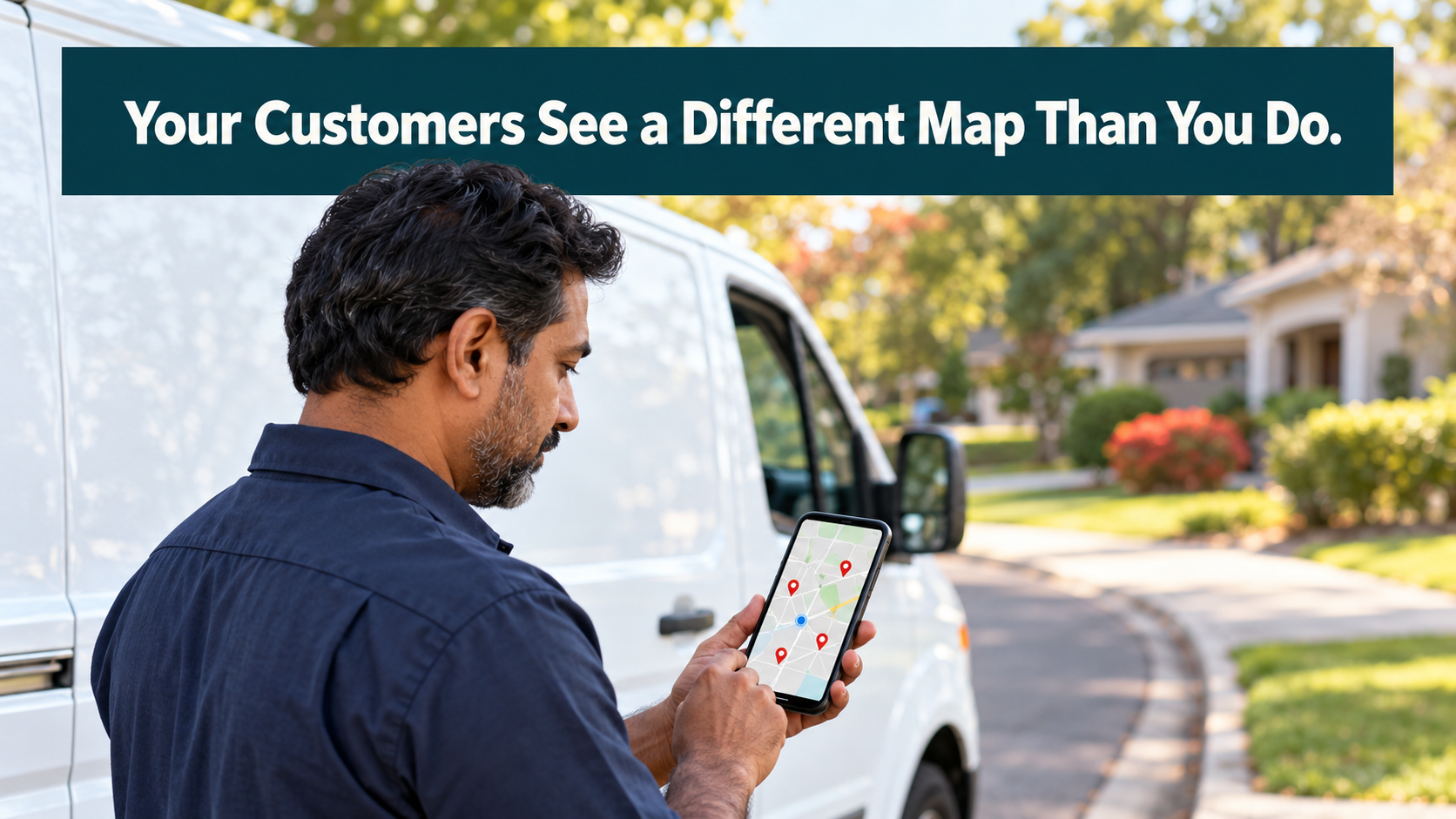
Both reactions rest on the same mistake. There is no single local ranking. Google assembles map results around each person searching, and one of the biggest inputs is where that person is. The result an owner sees from the office is one sample, taken from the spot where their own business is closest — which tends to make it the most flattering view they’ll ever get.
The gap between that view and what customers see is where local leads go missing. Someone searching for a plumber, a dentist, or furnace repair near them is usually ready to call someone. When a business drops out of the map results a few miles from its door, those calls don’t slow down. They go to whoever Google showed instead — and nothing in the owner’s weekly routine reveals it.
Key Takeaways
- Google says local results are based mainly on relevance, distance, and prominence, and states there is no way to request or pay for a better local ranking
- Distance is measured from the person searching, so every customer sees a slightly different set of map results, including the three-business “local pack”
- Checking your ranking from your own office overstates how visible the business is across the area it serves
- Common shortcuts — keywords in the business name, extra listings, stretched service areas — can violate Google’s guidelines and put the profile at risk of suspension
- Relevance and prominence are the factors a business can influence, and they’re built through accurate profile details, the right categories, reviews, and how the business is referenced across the web
What Google Says Determines Local Search Ranking
Google publishes very little about how local results are ordered, and it’s direct about why. Its Business Profile help page says there’s no way to request or pay for a better local ranking, and that it keeps algorithm details confidential to keep the system fair. What it does publish is a short list of three factors.
Relevance is how well a Business Profile matches what someone searched for. Google’s guidance is to provide complete and detailed business information so it can match the profile to the right searches.
Distance is how far each business is from the person searching. If the searcher doesn’t share their location, Google uses what it knows about where they are.
Prominence is how well-known a business is. Google says this draws on information like how many websites link to the business and how many reviews it has, and that more reviews and positive ratings can help local ranking. The summary line on that help page currently says “popularity” where the subsection below still says “prominence.” The meaning is the same: Google is weighing how established and recognized a business is, not just what the profile says about itself.
The breakdown most owners run into is treating all three factors as things the profile can fix. Only relevance lives mostly inside the profile. Distance can’t be changed at all. Prominence is built largely outside the profile — across the web and through customers. Owners who put every hour into profile edits end up polishing the one lever that’s often already in decent shape, while the two that decide most outcomes go untouched.
Why the Map You Check Isn’t the Map Your Customers See
Because distance is measured from the searcher, the local pack a customer sees on the north side of town can look nothing like the one a customer sees downtown. Each searcher gets results built around their own location, and the business that ranks first from its own parking lot may not appear at all for a homeowner eight miles away.
This is the part of local search ranking that owners rarely measure, and it’s often the part that explains a slow quarter.
The following is an example to illustrate how this works in practice — not a specific client case study.
A heating and cooling company operates from a shop on the east edge of a mid-size metro area. The owner searches “furnace repair” from the office every few weeks and consistently sees the business in the top three map results. Over two seasons, calls from the west side of the metro — historically about a third of the company’s work — fall off noticeably.
The owner’s first move is to rework the Business Profile: new photos, a rewritten description, a longer services list. Nothing changes, because the profile wasn’t the problem. From the west side, three competitors sit closer to the people searching, and the company isn’t prominent enough to outrank businesses that close. The ranking the owner kept checking was real. It only described one corner of the market.
The fix starts with measurement, not edits: checking results from several points across the service area to see where the business appears and where it drops out. Grid-based rank tracking tools do this systematically. A manual version is running the same search from job sites in different parts of town. For a service business, the result is effectively a revenue map — every neighborhood where the business doesn’t appear is a neighborhood where growth depends entirely on referrals.
Four Assumptions That Keep Businesses Out of the Map Pack
Most local visibility problems we see don’t come from neglect. They come from reasonable-sounding fixes that work against how Google evaluates a business, or against its rules.
Assumption: Adding the service and city to the business name will help
Google’s guidelines require the profile name to match the business’s real-world name, as used on its storefront, website, and stationery. Service descriptors, location details, and taglines in the name aren’t permitted, and Google states that unnecessary information in the name could result in suspension of the Business Profile. Whatever lift a keyword-heavy name appears to give, it isn’t worth a profile that can vanish from Maps while a reinstatement request works its way through.
Assumption: More listings mean more coverage
Google allows one profile per business location. A service-area business gets one profile for its central office with a designated service area, and a separate profile is only allowed for a location with its own service area and its own staff. Virtual offices aren’t eligible. Google also notes that more than one profile per business can cause problems with how information displays on Maps and Search — the opposite of the coverage the extra listing was meant to create.
Assumption: A bigger service area reaches more customers
The service area tells customers where the business works. It doesn’t change how far the business is from the person searching. Google asks that the service area be accurate and precise, and says it generally shouldn’t extend beyond about two hours of driving time from where the business is based. Drawing it wider doesn’t move the business closer to anyone. It only makes the profile a less precise description of the business.
Assumption: Map ranking lives entirely inside the profile
Two of Google’s three factors reach well past the profile. Prominence draws on links to the business and on reviews. And Google says it can detect category information from a business’s website and from mentions of the business across the web. A website that doesn’t clearly describe the work, or a business that’s rarely referenced by anyone locally, weighs on how Google understands it — no matter how complete the profile is.
What Moves Local Search Ranking and What Doesn’t
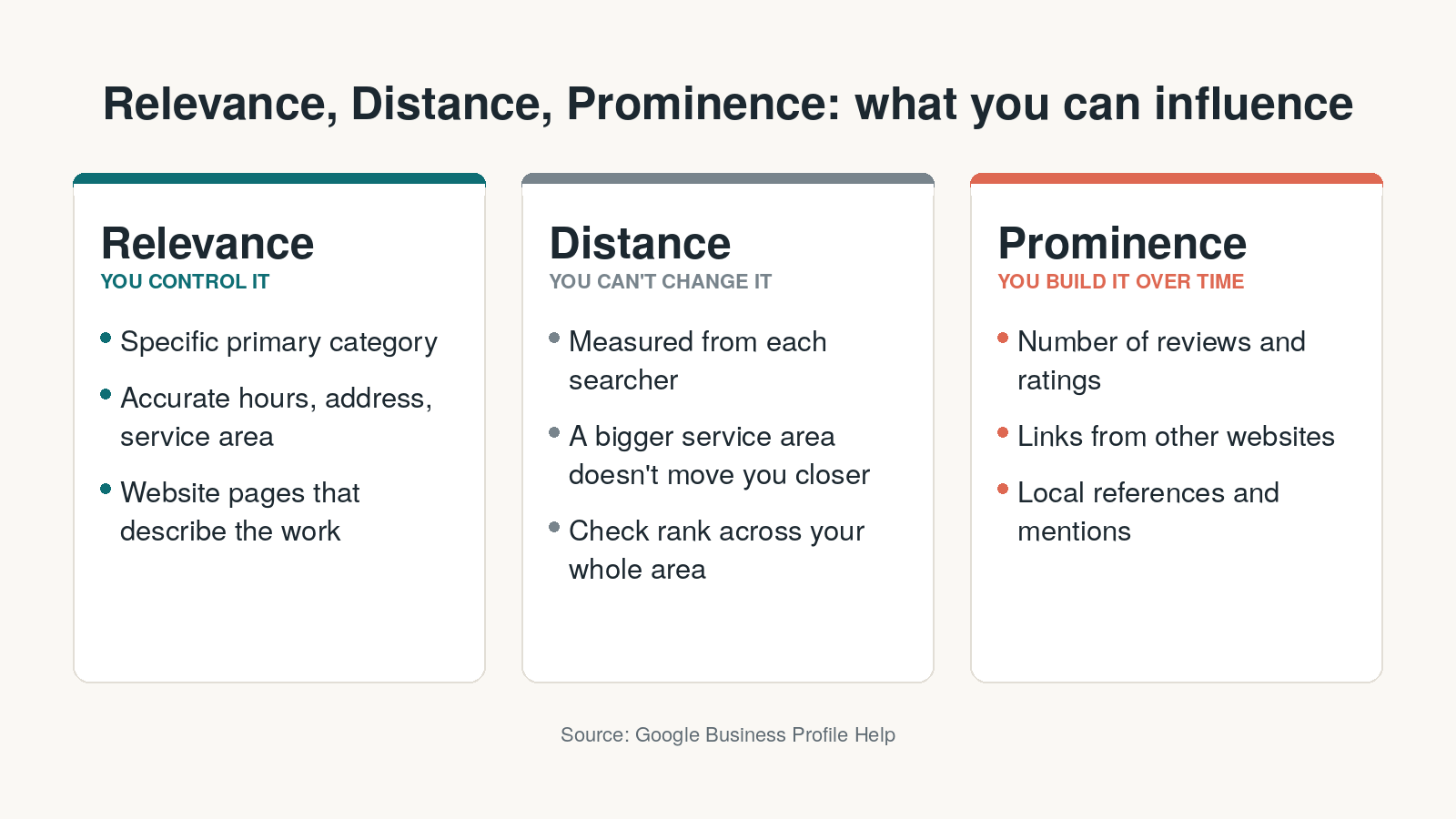
With distance set aside, the work comes down to relevance and prominence.
Relevance starts with categories. Google asks businesses to choose the fewest categories that describe the core business, and to pick the most specific ones that apply. It frames the test as “this business is a,” not “this business has a.” A business that lists a broad category, or piles on categories for services it offers occasionally, tells Google less about what it does, not more. Accurate hours, an accurate address or service area, and a clear description of services fill out the profile side. On the website, service pages that describe the specific work in plain language give Google a second source confirming what the profile says.
Prominence is slower. Reviews are the part Google names directly — both how many a business has and the ratings. Google also recommends replying to reviews, noting that positive reviews and helpful replies help a business stand out. Links count too: Google lists how many websites link to a business as a prominence input, which is why being referenced by real local organizations — a trade association, a supplier’s dealer page, a community sponsorship, local news coverage — matters more than most owners expect.
Paying Google doesn’t move it. Ads can put a business in front of local searchers, but they’re labeled as ads, and Google states that local ranking itself can’t be bought.
The tradeoff is time. Relevance problems are mostly one-time corrections. Prominence builds over months, one review and one reference at a time. A business that needs calls this month may need paid visibility to cover the gap while that slower work compounds — and it should know which of the two it’s paying for.
When the Map Pack Isn’t Where Your Next Customer Comes From
Not every business should put its marketing effort here. Google Business Profiles are for businesses that have a location customers can visit or that travel to customers where they are. A business that works entirely online isn’t eligible.
Others are eligible but won’t win many leads from the map: a firm whose clients arrive through referrals and industry relationships, a specialty business whose buyers are spread across several states, or a company based well outside the area where most of its customers search. For those businesses, a correct, compliant profile is still worth keeping — but growth usually comes from content, search visibility beyond the map, and the referral channels that already work. That’s a channel decision, and it deserves to be made on purpose rather than by default. It’s also a decision we help businesses make before they spend anything.
Where Peak Advisers Starts With a Local Visibility Problem
When an owner tells us the phone has gone quiet, the first conversation isn’t about the profile. It’s about where calls used to come from, where they come from now, and where the business shows up across the area it serves. That comparison usually explains more than any profile checklist.
From there, the order matters. We check the profile against Google’s guidelines first, because a name, category, or listing problem can put everything else at risk. Then relevance: categories, services, and whether the website describes the work the business wants more of. Prominence comes last because it takes longest — reviews, local references, and content that gives other sites a reason to mention the business.
We apply the same approach to our own site. For businesses without anyone in-house to own search visibility, that’s the work we take on.
Frequently Asked Questions
How long does it take to improve local search ranking?
Google doesn’t publish a timeline. Corrections to profile details — categories, hours, address or service area — are one-time fixes. Prominence builds gradually as reviews accumulate and other sites reference the business. Plan in months, not weeks, and measure progress across the full service area rather than from one location.
Can my business rank in a nearby city where I don’t have an office?
Sometimes, but distance works against it. Google measures how far each business is from the person searching, so businesses located closer to searchers in that city start with an advantage. A business that’s a much stronger match can still appear, but it has to earn that through relevance and prominence. Creating a listing at an address where the business doesn’t operate isn’t permitted.
Why did my business drop out of the local map results?
Common causes include profile information that became inaccurate, a competitor opening or strengthening its presence nearby, a guideline issue that led to suspension, or checking from a different location than before. Start by confirming the profile is live and verified, then compare results from several points across your service area.
Is it against Google’s rules to put keywords in my business name?
Yes, unless the words are part of the business’s real-world name as it appears on signage, the website, and stationery. Google’s guidelines list service information, location details, and marketing taglines as not permitted, and note that unnecessary information in the name could lead to suspension.
Does responding to reviews help local search ranking?
Google recommends replying to reviews and says positive reviews and helpful replies can help a business stand out. Separately, it says more reviews and positive ratings can help local ranking. Replies also do something no ranking factor does: they show the customer choosing between three businesses in the map pack that someone is paying attention.
Can I pay Google for a better map ranking?
No. Google states there’s no way to request or pay for a better local ranking. Ads can appear alongside local results, but they’re labeled as ads and don’t change where the business sits in the unpaid map results.
The Map Your Customers See Is the One That Counts
Local search ranking isn’t a number to check once a month from the office. It’s a map of where the business is visible and where it isn’t — and for a local service business, that map lines up closely with where revenue is coming from and where it’s slipping.
If the business looks strong from your own desk while calls thin out from other parts of town, the problem is measurable and the order of work is clear: confirm the profile is compliant, sharpen relevance, and build prominence where the business needs to be seen. Peak Advisers does this work for small businesses that want the result without adding a marketing role to someone’s week. If you want a clear picture of where your business shows up — and where it doesn’t — that’s a conversation we’re built for.