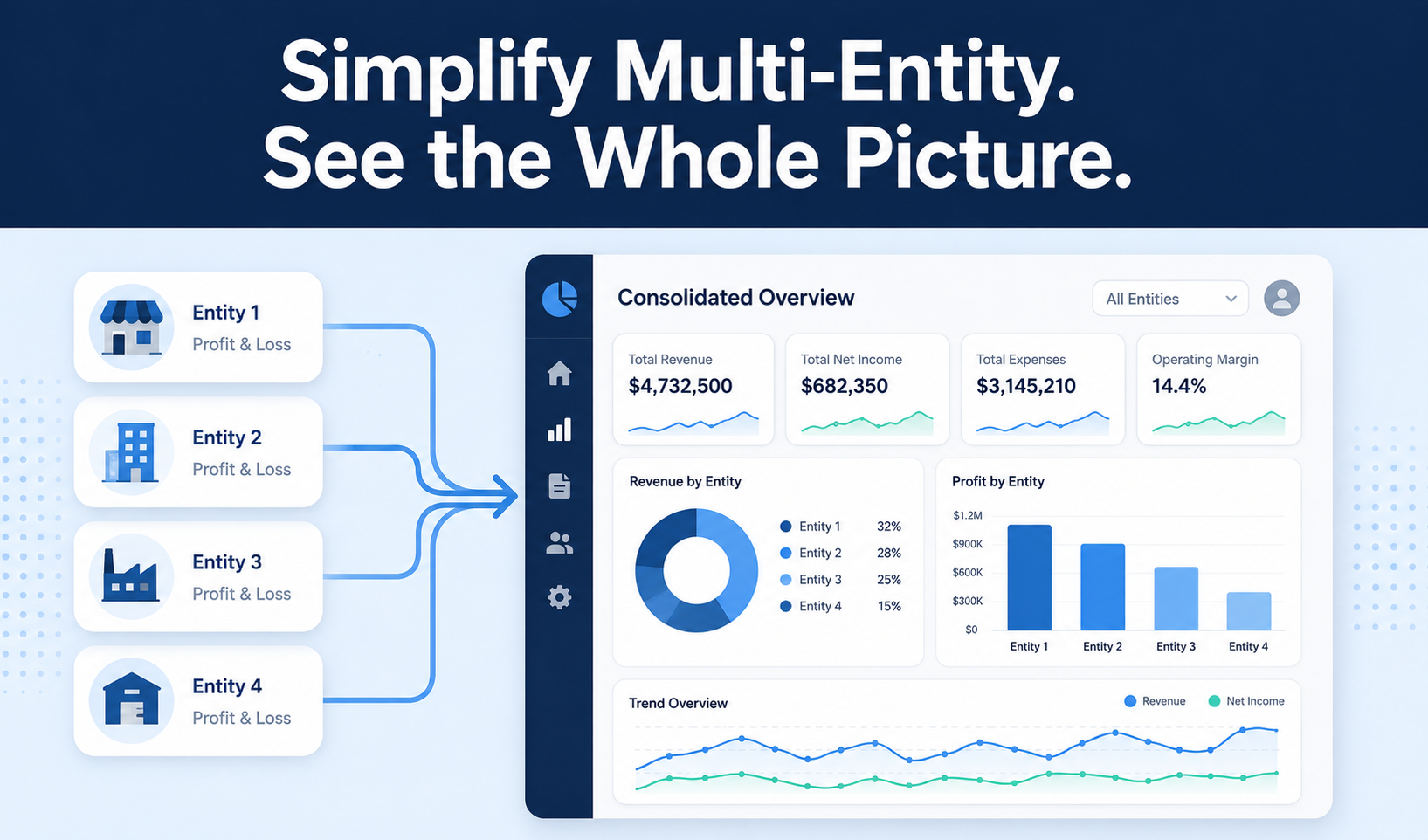
Intuit Enterprise Suite multi-entity tools just got a meaningful update. If you evaluated the platform for this kind of work earlier and moved on, it’s worth another look — the intercompany tooling has changed more than a typical update usually does.
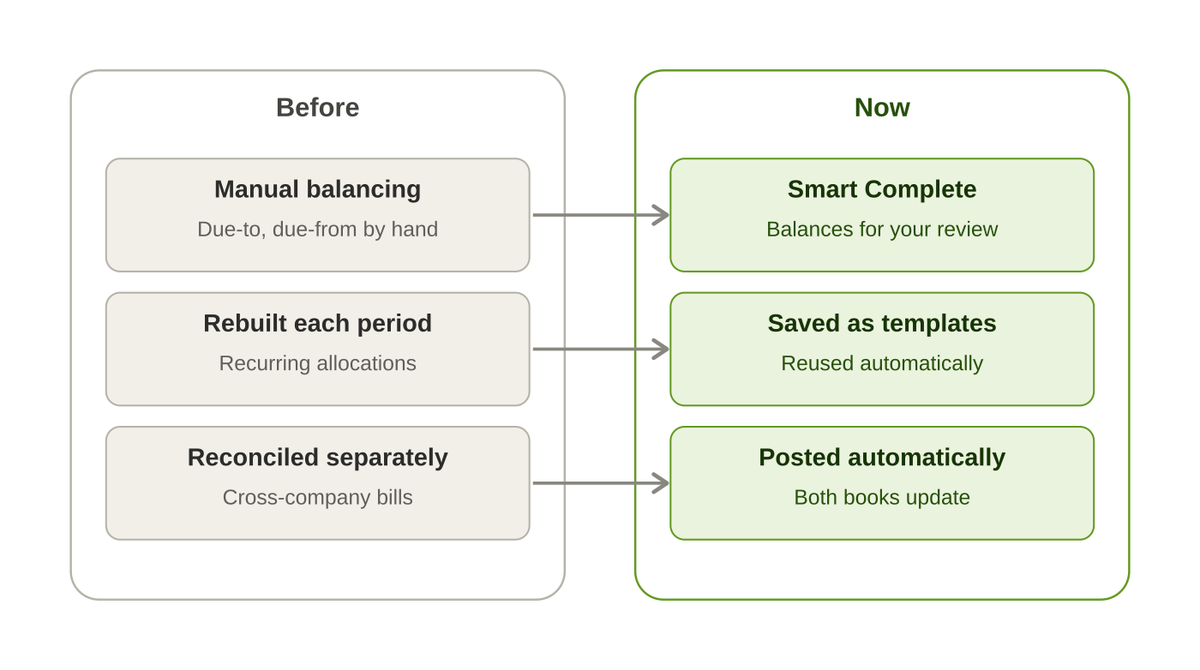
Manual intercompany close work — balancing due-to and due-from accounts by hand, categorizing intercompany bills one at a time, rebuilding the same allocations every period — is one of the most persistent bottlenecks in multi-entity accounting. This release automates a meaningful piece of it, and the automation is live now, not promised for later.
Key Takeaways
- Intercompany journal entries, recurring allocation templates, and cross-company bill payment all moved from beta to generally available in this release
- Dimensions now apply at the transaction level instead of line by line, cutting the manual tagging that multi-dimensional reporting used to require
- Several additional features — multi-currency, entity hierarchy enhancements, a cross-entity payroll hub — are in beta now, rolling toward general availability in the coming months
- A business that evaluated Intuit Enterprise Suite multi-entity tooling before this update was looking at a materially different product
- This doesn’t change whether a single-entity business needs IES — it changes the calculus specifically for businesses already managing more than one entity
Improvements in the Intuit Enterprise Suite Multi-Entity Update
Three intercompany features moved from beta to general availability in this update, after spending time in beta first.
Intercompany Journal Entry Smart Complete fills in balancing entries, intercompany contacts, and partner company details for review before posting — rather than a controller reconstructing those fields manually for every intercompany transaction.
Intercompany transaction templates let recurring entries and dynamic allocations be saved and reused, with an option to auto-post intercompany bills against rules the business sets, routing anything outside those rules for manual review.
Cross-company bill payment allows a bill in one entity to be paid from another entity’s account, with the offsetting intercompany entries posted in both sets of books automatically — no separate reconciliation pass required.
Dimensional reporting also changed in a way that matters for multi-entity businesses specifically: dimensions now apply at the transaction header level rather than requiring line-by-line tagging, and reports support multi-level pivots — holding several cuts of the data in view at once instead of building a new export for each angle.
What’s Coming, and How to Think About It
A second set of features is in beta now, with general availability expected to expand through the fall as part of Intuit’s Early Access Program: enterprise multi-currency (covering U.S.-dollar functional currency organizations now, with international currencies following), entity hierarchy enhancements, and a cross-entity payroll hub that consolidates payroll administration across entities into one place instead of company by company.
For a business currently evaluating IES, beta status isn’t a reason to wait and see — it’s a reason to talk to Intuit directly about scope, eligibility, and timeline for the specific features that matter to your situation, particularly if multi-currency or a unified payroll view across entities is part of what’s driving the evaluation.
Why This Matters More Than a Typical Release Note
Most software updates are incremental. This one changes a specific, well-known pain point that shows up in nearly every multi-entity evaluation conversation: the intercompany close is manual, it’s slow, and it’s the reason month-end takes longer with each entity added. Full technical detail on every feature covered here is available in Intuit’s own release notes for this update.
The businesses citing real time savings from this and the prior release aren’t hypothetical. Intuit’s own published case studies include a construction firm that cut intercompany month-end reconciliation time by 90% during peak season, and a multi-entity operator who described saving 10 to 15 hours a week once consolidated reporting and cross-company switching replaced manual spreadsheet work. Results like these vary by business, but they reflect real customers using features that are now generally available, not a roadmap promise.
Example: The Evaluation That’s Now Out of Date
The following is an example to show how this works in practice — not a specific client case study.
A specialty distributor operating three entities evaluated IES a year or so ago and concluded the intercompany tooling still required too much manual balancing to justify a migration. The team stayed on separate QuickBooks Online files, consolidating manually each month.
Revisiting that evaluation today changes the picture. Intercompany journal entries that previously required manual due-to and due-from balancing now complete largely on their own, with review built in before posting. Recurring intercompany allocations that used to be rebuilt every period can now be saved as templates. None of this eliminates the judgment a controller brings to the close — it removes the repetitive reconstruction work that used to consume most of the time.
The decision the distributor faces now isn’t the same decision they made back then, because the product they evaluated isn’t the product available now.
When This Update Doesn’t Change Much
If a business operates a single entity, the underlying question of whether IES makes sense doesn’t change — that’s still a function of overall financial complexity, not intercompany tooling specifically. And if a business already migrated to IES before this update, most of what’s covered here likely already applies automatically, since these are platform-wide changes rather than an opt-in module.
Where this genuinely matters is for businesses currently managing multiple entities on separate QuickBooks files, or businesses that looked at IES multi-entity management within the last year and decided the timing wasn’t right.
Where This Fits in the Peak Advisers Ecosystem
As a certified Intuit Enterprise Suite partner, Peak Advisers tracks these releases as part of ongoing client support — not just for new migrations, but for existing IES clients who should know when a platform update removes work from their monthly close. If your business evaluated IES previously and moved on, this release is a reasonable trigger to revisit that decision with current information rather than an evaluation that’s now several product cycles old.
How Peak Advisers Approaches This
When a multi-entity business asks us whether it’s worth reconsidering IES, we don’t start by re-running the original evaluation from scratch. We look specifically at what changed since the last time the business looked, map that against the specific pain points driving the question now, and give a direct answer about whether the gap that mattered before has closed.
Additional Resources
Frequently Asked Questions
Do I need to do anything to get these new features if I’m already on Intuit Enterprise Suite?
No — the intercompany automation, cross-company bill payment, and transaction-level dimensions covered here are generally available platform updates, not features requiring separate setup or an opt-in module. Beta features noted in this release require joining Intuit’s Early Access Program.
Is multi-currency support available now?
Enterprise multi-currency is in beta as of this update, currently covering organizations whose functional currency is U.S. dollars, with international functional currency support expanding over time. Contact Intuit directly to confirm current scope and eligibility before incorporating it into a multi-currency workflow.
How is this different from QuickBooks Online’s multi-currency handling?
QuickBooks Online supports multi-currency at the single-entity level. The IES capability referenced here is built for consolidating and reconciling currency exposure across multiple entities within one platform — a different problem than single-entity currency conversion.
Does this release affect migration timelines from QuickBooks Desktop or Online?
Intuit’s published data cites 95% of businesses completing migration in 30 days or less, and this release expanded what migrates automatically — including local tax setup, inventory costing method, and historical report data. Actual timelines still depend on data quality and the number of entities involved.
Should I wait for the beta features to reach general availability before migrating?
Not necessarily. The features covered as generally available in this release are usable today. Whether to wait on a specific beta feature depends on whether that particular capability is central to your decision — worth a direct conversation about your situation rather than a blanket wait-and-see approach.
The Product Keeps Moving — Evaluations Should Too
Software that’s evaluated once and never revisited creates the same kind of blind spot as an invoice nobody rechecks after the first look. Intuit Enterprise Suite’s intercompany tooling looked meaningfully different a year ago than it does after this release, and the businesses most likely to miss that are the ones who already did the work of evaluating it once and assumed that verdict still holds.
If multi-entity complexity is the reason your monthly close takes longer than it should, and the Intuit Enterprise Suite multi-entity update was part of a conversation you already had, it’s worth having that conversation again with current information.